In my previous post I tried to outline a way of thinking about the integrity of a work of art. The two main aspects that I think can be meaningfully talked about are clarity and connection.
In this post I’d like to take a look at a few specific works of art and present some examples of how I think the framework might actually be used.
Because the integrity framework provides for a broad range within a few overlapping spectra, I will be trying to pick works of art that show up in different areas on the plot.
Before I start looking at the first work I would like to talk a little bit about perception and subjectivity. Any reading of, or engagement with, art relies upon the unique perceptions, knowledge and lived experience of the viewer. I don’t hold that there can be an objective “truth” in regards to the meaning or value of works of art. Everyone will find something different. Rather, having such a framework as this will actually provide us more opportunities to talk about art with a common language.
I am working from an assumption that any given work of art takes into account three nodes and brings them into some sort of relation. First, the work of art itself. Second, the viewer (listener, etc). Third, the “object” of the work. Determining the object of a work may not be a precise science. It may be what is depicted within the work (the Mona Lisa might be about the woman), or it might be about the technique (a Jackson Pollock might be primarily about the process by which he created the piece rather than what is on the canvas). Part of talking about the integrity of a work is talking about what the object of the work is.
The way in which a work of art bring the viewer and the object into relation is a sort of triangulation of perception, values and other aspects. Integrity has to do with the ways in which a work of art creates and sustains this triangulation.
I may not agree with you, or even see the same relationships within a work. Indeed, the same viewer may see quite different relationships within a work during a second or third viewing. Learning more about the context, the history, the artist, the method, the subject…all of these changes in perception will change the reading.
Again, the language of integrity isn’t about determining a static quality of the work. It is about giving us a way to share our experiences of a work using a common set of ideas. I hope it will allow us to discuss some of the ways that art influences the cultural conversation, and how we feel about that.
Having said that, let me try my hand at some actual examples.
Example 1 – “Surprise” William Merritt Chase, 1883

Let me start with Clarity:
This work is pastel on paper at a time before digital art was an option. The creation of the piece was likely done using a sitter in a studio, and given the posture of the subject it seems unimportant that we know exactly who this person is.
Chase uses a stylized realist style which aims to depict many things with significant accuracy to real life, and yet he chooses to emphasize and extend the qualities of light and texture, especially as it comes to the woman’s clothing. The background and flowers are both lacking in the same level of detail as, say, the rendering of her hand, which seems to place more emphasis on the person herself rather than her surroundings.
There is some ambiguity here in regards to what Chase would like us to focus on. On the one hand, the woman herself is rendered most accurately (that is, her flesh, her posture and proportion). In an image where the other elements are either made somewhat more fantastical, or less clear, the question arises whether the focus is intended to be on what is most real, or what has been made unreal.
Without doing any research into Chases’ notes for this work, and not being a Chase scholar, I can bring no outside perspective.
On the whole I would say that though the image seems presented straightforwardly to us as a portrait, there are some challenging elements which call a simple focus into question. I would describe this as fairly clear though somewhere between clear and opaque.
In terms of connection I see a tension between representation of the sitters outward and inner appearances. I do not know whether the outfit would have been reserved for the elite, or available to the middle class of the period. It does not seem likely that it would have been seen as something for the lower classes of viewer. This sets a certain distance between the woman in the painting and many viewers. It does seem to me that she is of an upper class, and because she is so carefully made up we might suppose there is a specific occasion for which she waits.
Where I find connections being built, however, are within how the woman is depicted aside from her dress and surroundings. Without being able to see her face we see most of her character and mood through the tension within her body. The twist of her neck as her attention is suddenly drawn away, and the way she grips her seat, belies perhaps an anxiety about what is ahead of her. I think the stylistic difference between the way she (in the flesh) is depicted as opposed to the softer treatment of her clothing, is a way for us to step aside from her class and standing and empathize with the human and visceral reaction she is having. The visual discrepancies perhaps allow us to build a bridge animal to animal.
In this way the object to which I am connected is the human aside from her class and standing. A human who perhaps has trepidations about what is coming even if it appears to be a happy occasion for which she is dressed.
And connected I am. I feel the sympathy or empathy for what she might be feeling.
In this way I find the work to have high positive connectivity.
High connectivity and significant clarity would lead me to describe the piece as having high integrity.
Example 2 – “Sun Spot in Cracked Mud Capitol Reef” Minor White, 1961
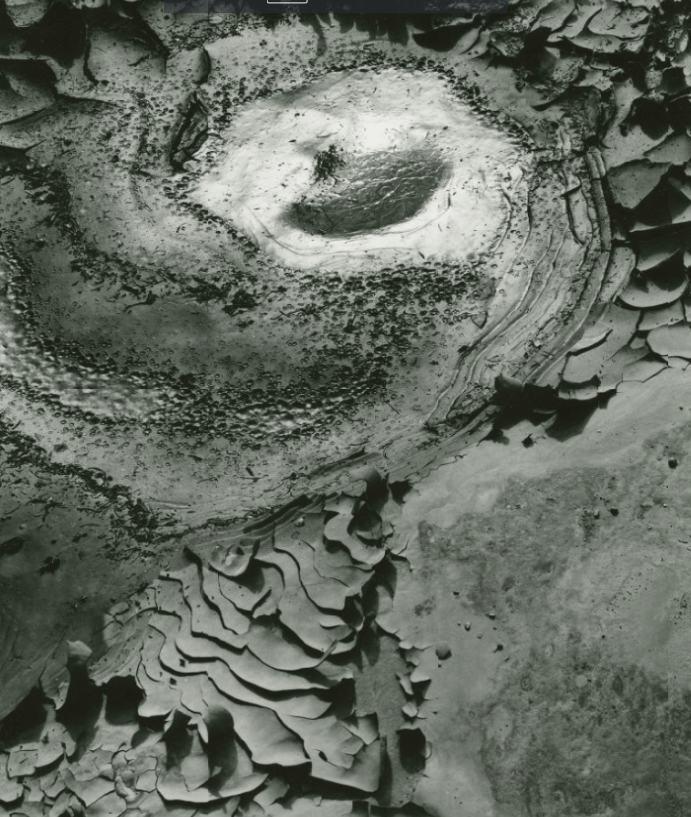
First glances at many of Minor White’s images do not always provide answers about what one is looking at. Most of his natural subjects, like this one, are closely cropped and from a very short distance away. The blocking out of perspective and context makes it difficult to place them at first. This one, as the title describes, consists of patterns within cracked mud.
Once we have looked long enough, or been given the right clue, however, White’s work arrives with absolute clarity. Though providing his forms in a way that limits our exposure to them, he nevertheless strives to present them as exactly what they art, in detail and crisp clarity. They are exactly what they are, and it is only our odd placement which make us see them as novel.
It is exactly this forced juxtaposition which makes building a connection with the object more difficult. We see the mud, and understand the mud, but it does not register in the same way. In fact, I would argue that his work is specifically about disconnection. It is about breaking down our preconceptions of the world around us.
So, high level of clarity presenting a high level of disconnection. I would say that this is also a work of significant integrity, but caot be included in quite the same category as the previous work.
Example 3 – “Rabbit” Jeff Koons, 1986
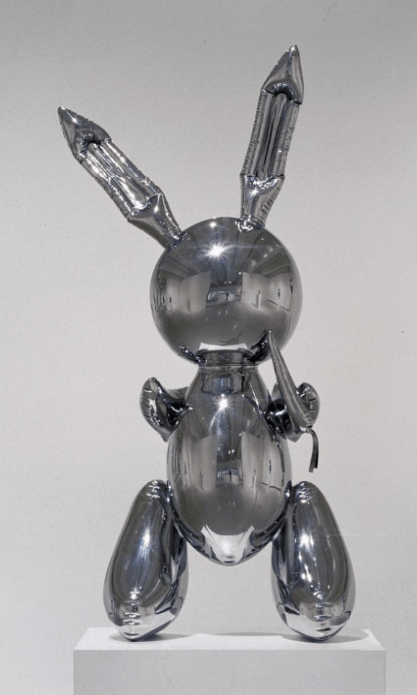
There are multiple levels of ambiguity and/or deception taking place within this piece. First is the materials themselves. The sculpture is crafted out of stainless steel that has been meticulously crafted and detailed to appear as if it were a helium balloon. This is an intentional blocking of our ability to accurately perceive and understand the piece. There is, however, no secret that it is metal, and the artist has made a name for himself producing many works that follow this type of execution. So, knowing anything about Koons is to potentially be familiar, thus lowering the impact of the artistic deception.
A secondary deception has been called out by others in the art world who feel that Koons also misleads people by presenting himself as a singular artist when in fact he has a large workshop making these sculptures for him. Depending on the viewer this may constitute another level of deception.
Since I have not spent much time studying Koons I will keep my view focused on the deception within the materials, and rate this as Deceptive in its level of clarity.
I come up a bit challenged when I try to place an object within the piece. It certainly isn’t about rabbits or balloons for me. It must be about this deception of materials and a challenge of my own perceptions. Similar to White’s work I see potential that it is trying to disconnect me from what I think I know. I certainly don’t feel more connected to anything while regarding this. Perhaps there is a whiff of anti-capitalism or materialism here as well, both of these are forms of disconnection too.
Because the object of th work seems to be this odd deception of materials, that must actually increase the clarity of the work somewhat. If I am intended to see how this is not a balloon, then can it be called deceptive in trying to trick me in the first place?
A work that aims to disconnect the viewer in a deceptive, but not maliciously deceptive way. Still, playing quite low on the level of integrity.
Example 4 – “The Electrician” Boris Eldagsen*, 2022

Let me start with connection on this one, for reasons that will become clear later. Two women, one older, one younger, probably mother and daughter, appear together. The mother holders her daughter at the shoulders, perhaps comforting, but also gripping, even holding herself up. The younger woman looks ahead perhaps to a mirror, seeming to see her mother’s face in the reflection. Her own look is resigned, tired perhaps, concerned. It can be read as a commentary about a complex relatioship. Something we all share with someone in our lives, especially the experience of being a parent or child, or having the expectations of someone weighing on your in one form or another. There is much content here from which one can read forms of connection. The object is not directly obvious to me, but I seem to be reacting to this nexus of intertwined relationships which bridge me to elements within my own life. This image displays high levels of connectivity for me.
Clarity, though, becomes an issue quickly. The image appears to be a vintage photograph, but there are elements which seem too smoothly rendered, even illustrated.
The truth is, this image was *generated using Dall-E 2, a text to image generator that runs on AI. The artist created this with the intention of entering a photography contest to see i they were “ready for AI”. As he notes after the fact “they are not”.
Eldagsen’s image won first place at the competition, which ceratinly makes for an interesting story, but isn’t the main focus of my attention here.
His intention of entering the contest only highlights for me that he didn’t craft the image for any specific purpose other than it had to be something that might pass for the competition. This is disingenuous in terms of clarity because it signals that no matter what connection or meaning we read within the image, they were not placed thereby the artist as part of their process. These elements are accidents at best.
A secondary complication about AI-generated art is that they occur as output and input. The “how” of being made cannot be known even to the artist. This makes the work both deceptive and opaque in terms of clarity.
So, even with high levels of connection, because they are both opaque and disingenuous, we must read this as a piece of very low integrity.
Doing this experiment already taught me a lot about how the framework might be used. I have some thoughts and further developments, but I would very much like to hear what others think. Is there something useful here? Do you disagree with my readings? Does the system make any sense at all?
More thoughts on what this means for the bigger picture of art discourse are my next project. Perhaps looking at some of the broader applications will help to bring out what I find so intriguing here.
Thank you for taking the time to follow along with me.
 Wandering Path Arts