I am reading the book book “China Root: Taoism, Ch’an, and Original Zen” by David Hinton (Shambhala Press, 2020). In it, he traces the movement of Buddhism as it traveled to China from India, and then on to Japan and the west. He looks at the transformations that occurred as Buddhism encountered the ancient Chinese traditions, notably Taoism, and how what emerged and became “Zen Buddhism” has perhaps more in common with Taoism at some fundamental levels.
His primary tactic in this exploration is to look at Chinese words, characters, that hold critical meaning for Ch’an (Zen) and Taoism. By tracing back the entomology of these pictographs he draws links to Taoist ideas that seem to have permeated the Buddhist thinking and subsequent teaching.
This exploration of Chinese language points to a unique framework for understanding that remains quite distinct from traditional western conceptualization around language.
“And indeed, language is described this way in the Judeo-Christian myth that still shapes Western assumptions in fundamental ways, for the language of humans was God’s language at the beginning, so it oddly predates the physical universe. When language functions in this mimetic sense, it embodies an absolute separation between the identity-center (“soul”) and reality. And that separation defines the most fundamental level of experience.”
China Root by David Hinton, Page 42 from the section titled “Word”.
The Western mind has amazing capabilities to segment out portions of the world for examination. it is adept at plucking one idea, ridding it of any nagging context, and examining it as if it existed in a vacuum. This is the hallmark of western scientific method and reductionist thinking.
Chinese pictographs, and the characters which evolved from them, Hinton writes, maintain a direct visual connection to the thing which they seek to describe. This picto/linguistic root maintains a connection to the natural world, a lifeline to something “real” rather than simply conceptual.
The way this operates makes me think of a tablecloth spread out on a flat surface. One seems the whole cloth, but may pick up any small section at a time to give a name to. That small section of cloth may, for a time, be considered on its own, but remains connected to the whole. When it is released the segment which was described returns to its context within the larger whole. Indeed, it was never disconnected, only artificially segmented out, from that whole.
Not only the pictographic roots, but also the method by which characters combine and convey meaning in Chinese. Characters are often made up of other characters, gaining meaning through the compounding and relationship of ideas one up on the other. In addition there is not conjugation. Characters can be both verb and noun, and can mean multiple things in relation from one usage case to the next. Here too we see that the words themselves do not remain static like 1’s and 0’s. They are not read alone but must be considered taken together and taken in the context of which they are encountered (on a painting, newspaper, spoken word, etc).
Western language, on the other hand, can be dialed in to attempt a highly specific context-free meaning. Indeed, the ongoing experiment of western language and philosophy is to continue drilling every more finely towards specific shared understanding of concepts so that they can be shared and passed on with the least amount of misunderstanding.
At a fundamental level the Western language sees things as separate units or elements, whereas the Chinese language names elements within a whole. Western language strives to be sterile and liberated from contextual requirements, while Chinese cannot be understood without taking elements into relation with one another.
Imagining a universal sense of oneness may not be quite so esoteric if one’s native language automatically assumes this sort of fundamental connection. Whereas, to the Western perspective it may certainly feel abrasively foreign. It is not simply a matter of perspective, but must be tunneled towards through the inherent barriers of the language itself.
For me the lens is a powerful representation of how language both inhibits and shapes our perceptions. Looking through a lens is like grasping at a bit of tablecloth. Temporarily we are able to extract a portion of our world out from that which is exists.
Depending on whether one seeks to extract the subject from its context, or work within the situation one is presented, regarding an image through the lens forces us to temporarily name it and treat it differently.
It is perhaps telling that, regardless how carefully we seek to regulate the background, adjust the lighting and tune the focus, the context can never be eliminated. When we cease looking through the lens, our subject is revealed as it always was, an entity within the wide and wild world of interconnected “things” and relationships.
This is an invitation for visual artists to submit work for an online exhibition centering on the theme of what it means to be a Taoist today, especially from the perspective of someone in the “global west”.
Entry is open to anyone and for any kind of 2D work that fits within or relates to this broad theme. Works must be original work of the artist who submits it. AI-generated work is not automatically disqualified, but I am especially interested in works that have been consciously crafted by the hand and thought process of a human artist.
Are you or your work inspired by Taoist philosophy, religious practice, martial arts or cultural heritage? is your practice informed by Taoist thought, or one of the major themes such as nature, balance, harmony, we-wei, yin-yang, flow, change, cycles, alchemy, etc?
My intention is to showcase this work for an extended period of time, available for viewing online. I will be selecting individual works, selections of works, or artists to feature with focused articles so that we can foster a conversation around the topic.
I am deeply interested in how we can cultivate a conversation around art and artmaking, and bring visual art more clearly into the conversation. How can artists addressing this theme help us to think about these ideas in a new way?
There is no cost to submit work, and I will include all images unless they are of too poor a display quality, or if there are excessive issues with content.
Interested artists (and non-artists) may submit their work through the form linked below.
Moonlight, or drifting clouds, when encountering the ridge, spend not a thought about whether, and continue to fall, heart first, drawn to the unseen path they were already bound to follow.
[Original artwork “Natural Divide”, digital silkscreen, copyright Andy Peterson 2024]
We are at war with ourselves. The ways in which we have organized the superstructures of western society are actively degrading our ability to be humans in the most meaningful ways.
I wrote that first paragraph while I was in a very different world of work. Part of a multi-national corporate system wrapped within an even larger one.
It was an organization where the best intentions were increasingly boxed in with layers of programming meant to protect us from “risk”. Each new operating procedure and tool was meant to help us become more efficient at the tasks, while also making it increasingly more difficult to make mistakes that could cause real harm to the business.
For an organization whose roots grew deep in the soil of being actual humans trying to do good, it had become a series of wheels within wheels where the individual was verbally celebrated while also being handled as a liability.
We don’t intend to do this. I believe that when employees are told that new systems are meant to improve their work, it is an honest sentiment. The problem is that “improve the work” focuses on taking out the tricky bits. It involves efforts to remove ambiguity and misunderstanding. It clarifies roles and responsibilities and limits the scope of each person’s agency.
Certainly, knowing what one is responsible for, what success looks like, and what the timeline is are all pieces of information that can give an employee confidence. Moving beyond that to dictate exactly how, when and where the work is to be done begins to cut away at the things which make us human. The ways in which we can bring pieces of ourselves to the work that we do.
Our quest for risk-proofing the work removes the “stress” of thinking about certain elements, while also removing the necessity to think, and reason, and be creative.
These are things that bring meaning to the work.
I managed to get out, and that isn’t a small thing.
Being in the system, especially from the beginning of one’s career, means that it becomes the “norm”. The system seems like it makes sense. Especially for someone like me, who loves to understand the way things function. I like to know how to be effective and efficient and useful. I like to get a sense of how the pieces fit and why. It helps me to know what my task means for others who are working downstream.
Our corporations are built on chasing metrics. Find something, quantify it, and organize a way to achieve it. For a species of natural problem-solvers it feels good to have a clear goal. So, we create more of them. We attempt to quantify every piece of the equation.
It becomes easy to think that everything can be quantified and targeted, because so much focus in an organization such as this revolves around eliminating what cannot be quantified.
I became accustomed to it because it was comfortable.
The world outside of work had a tendency to look frustratingly disorganized, chaotic and irrational.
There are major problems out there, why aren’t we just focusing on rational solutions and making a plan?
At the same time, there was always a voice telling me that there was discovery to be made in this world beyond my work.
I had been lucky enough to travel and see beyond the boundaries of my imagination. I had moved away from home at a time when my life became fully my own to decide. I had met someone who came with a wonderfully diverse set of experiences and perspectives that challenged my own.
I had made a lot of art, and run many miles.
Still, the choice to leave my comfortable world of corporate work wasn’t one I made of my own accord. I had become disillusioned and suspicious, but it wasn’t enough to tip me out of my comfort zone.
It was the ultimate expression of corporate compassion for them to ask me to leave after 15 years of strong service for no other reason than my current position didn’t fit into their new model of risk-reduction. Keeping me around would have made me an outlier, despite the fact that I had been hired as something of an outlier into a position that was successful for the team.
I didn’t leave on my own because the siren-song of the the system is strong enough that it had narrowed my perception of the possible.
When I was out I spent my time seeking something to replace it. I had trouble marketing myself and looking for a new position because I could only describe myself as a piece within the larger machine. I didn’t know what else I was bringing to the table and I couldn’t describe my less definable strengths to others in a way that they could grasp. I didn’t quite understand them myself.
I am passionate about the limitations of the corporate world because I have lived through them. While I was a part of that system I became aware of how damaging it was to my own sense of self-worth. It robbed me of my agency and deprived me of the ability to find meaning in the tasks I was expected to carry out.
What I am only realizing now is that these aspects became my world. We adapt to our surroundings. Our perspectives are shaped by the hours of our day. Modern corporate working jobs shape the way we perceive the world. They shape the possibilities that we see for ourselves. They shape how we think about handling the issues we face. They shape how we handle social encounters, our friendships and even our family interactions.
We become used to the hierarchy, the rigid structure, the layers of expectations, roles and responsibilities. We expect that issues are someone else’s problem to deal with, and we grow accustomed to having our voices drowned out by others with more authority. We relinquish our decisions to those with “influence” and “power”.
I am thankful to be surrounded by artists, activists and those who are trying to lead with their hearts. I am thankful to be part of an organization that doesn’t always know how to get from point A to point B because we are not always sure quite where that is.
Life is disorganized and unquantifiable. “Solutions” do not come cleanly and without confusion or trade-offs. Struggling through opinions and obstacles gives valuable perspective. Learning to collaborate and iterate provide new insights and opportunities.
I am thankful to be surrounded by artists, whose struggles each day are to bring into the world something intangible which has not existed before. That is the closest thing to a genuine human struggle that I can think of, and being in it helps me to encounter my wider world with a different set of eyes.
I believe that art takes shape in response to the realities in which it exists. Art is a mirror held up to society. It is a canary in the coal mine. To read the story that is being told by art is to catch a glimpse of what is going on beneath the surface of the culture.
As most of us know from first hand experience either making or consciously seeking out art, it is not simply a passive symptom of what is going on “out there”. Art is an active force that influences the waters from which it has emerged.
The push and pull between nature versus nurture will never cease, but no matter how controlling the society or how powerful the aesthetic edicts within which artists were working, there was always the magic of humans exploring their curiosity in ways not quite understood even by them.
I think it is helpful to consider art in the same way we describe the immune system. Artists are often creating as a means of addressing the deep seated needs and desires which they otherwise struggle to express. Art appears in the form of what we think we need in that moment, in that era. To look at art from the broad scope of generational change within a changing society is to see clues about what the artists were seeking.
Renaissance artists were seeking mathematical perfection and organization within their linear perspective. They were seeking knowledge about the workings of light and the eye, and therefore ways to better place the human within a world that was suddenly framed not by religious belief, but by scientific assessments.
The German Romantics were seeking deep emotional connections to a shared past that had never truly existed. They were feeling swept away by tides raging on all fronts not of their own making, and they were perhaps looking to tap into a root of emotional power that had been blindsided by the ever advancing powers of steam and steel to shape the industrializing world.
To look back at the trajectory of art within the twentieth century within America and much of Europe is to see a retreat from common grounds of aesthetics. It is to see lines dissolving ever more rapidly which had once separated what was acceptable or reasonable or even meaningful. As the branches of scientific knowledge began multiplying ad-infinitum, and psychological studies opened up vast landscapes within the individual, we see extreme amounts of separation of one person from another. Artistic movements, though extremely problematic to characterize, had once been built upon some senses of shared aesthetics and grounding values. Suddenly, art became about slipping, and then breaking, those boundaries.
One may call it exploration, even liberation, from what had come before and the stifling rigidity of academic schools. Another take, considering art as symptom of underlaying ailments, is that art has retreated to a place from which it can help us come to terms at the most fundamental level.
Instead of building common ground as a society, or even as a close knit group of like-minded individuals, art now serves the unique voice of one person at a time. It is often a pure expression of one person’s experience of being human, and often their struggle with it.
What does it say about our world and our society, that the art we make seems mostly about trying to come to terms with ourselves as individuals?
The Tide of Disconnection
Simone Weil, a philosopher and activist writing about the changes taking place in her home France during the Nazi occupation and the ongoing impacts of industrial revolution, wrote a deeply important book outlining a need for deep connection.
She talked about what she called “rootedness” as a fundamental human need. The need for us as a species to be connected to something outside of ourselves in the world, as well as to each other. This sense of connection is something I would place within the camp of aesthetics in the Kantian sense, a non-rational bodily connection that hits us at a level below language and reason. It is a sense that we stand in important relationship to something else. This relationship gives us a sense of grounding and perspective on our lives and our place within the larger world.
So much that characterizes the modern era has to do with how we have lost (or torn out) these roots. Technology and social changes have made it difficult for people living in modernized societies to have any sense of innate connection with their world.
I have been following the writing of another person who describes poignently the advancement of the “machine” and its effects upon us. His writings have done an excellent job putting my own thoughts into words so that I can better frame and discuss them.
While quickly searching for a simple link back to some of Simone Weil’s writing to include in this post, I found a wonderful piece of writing about her work that summarizes her ideas. I did not recognize the name of the author of this article, but was unsurprised to find that it was the same man, Paul Kingsnorth, whose work I had been following.
It seems some connections are just waiting to come to light.
This is all to highlight how unbalanced our society is in favor of disconnection. Specifically, the currents of the modern world are most impactful in their ability to tear us away from the traditional cultural roots, and roots of place, that once brought us a sense of meaning.
To take this understanding of our modern world as full of tidal forces working to unmoor us from one another, and from the natural world, I believe we must consciously consider the role of art as a connective force. One with a unique ability to navigate outside of the corporate sphere, and one which links strongly to cultural sensibilities which are desperately needed.
To accept that art can be a vitally important vehicle for reestablishing connections is to beg the question about what art “should” be doing with this power.
My own conscience has been pulling me towards a moral code for artists and critics which orients these works within a framework of integrity. This integrity which I have been exploring is the spectrum of connection, and the honesty and clarity with which it is pursued.
For artists this is a call to consider what role the work has in the world once it is released. Does it speak with a voice that has the power to build or inspire connections? Between whom and what? Is it created with a reference for others to grasp hold of? Does it continue conversations of other traditions and media that viewers will be able to link back to? Is it hopeful, or encouraging or enlightening?
No artist should feel themselves compelled to change their vision, but it is worth asking against such as backdrop: is there a place for art whose intention is separation, disintegration or nullification? If it is, then does it at least offer a sense of hope with the other hand? Can we handle the weight of yet another disruptive force?
The onus on critics is perhaps even greater. An artist may need to create something darkly powerful in order to tap into a necessary inner well of strength and healing. Some works will be in their power challenging as well as hopeful. Much of the influence of art is in the balance of destruction and creation, and the destabilizing of what we think we know.
A critic has the responsibility to frame these works and help to translate them to the public. A critic can increase the impact which a work of art can deliver to the world. It is a great burden that cannot be lightly carried.
I challenge critics to help us interpret art with an eye towards connection. If the integrity of the world comes from a sense of clarity, then the critic can be the key to open up worlds of meaning and possibility. To do so with a focus on how the work can be a positive force for reconnection and the building of roots, is a noble calling of our time.
The faster and further our world rushes out from under our feet, the more important it will be to find ways to remain rooted. As we become tossed in a world of AI generated images, and corporate-sponsored content, it will become ever more critical to stop and think about where we find meaning.
Let us err on the side of connection.
While navigating what to say about the post-post-modern world, many names have been floated. One of them is “new sincerity”. It does not feel like that has caught on in a meaningful way, but I believe it connects most strongly with what we need right now.
Connections that are fresh, born out of vulnerability and the willingness to bear our desire for connection with clarity. With sincerity. With integrity.
In my previous post I tried to outline a way of thinking about the integrity of a work of art. The two main aspects that I think can be meaningfully talked about are clarity and connection.
In this post I’d like to take a look at a few specific works of art and present some examples of how I think the framework might actually be used.
Because the integrity framework provides for a broad range within a few overlapping spectra, I will be trying to pick works of art that show up in different areas on the plot.
Before I start looking at the first work I would like to talk a little bit about perception and subjectivity. Any reading of, or engagement with, art relies upon the unique perceptions, knowledge and lived experience of the viewer. I don’t hold that there can be an objective “truth” in regards to the meaning or value of works of art. Everyone will find something different. Rather, having such a framework as this will actually provide us more opportunities to talk about art with a common language.
I am working from an assumption that any given work of art takes into account three nodes and brings them into some sort of relation. First, the work of art itself. Second, the viewer (listener, etc). Third, the “object” of the work. Determining the object of a work may not be a precise science. It may be what is depicted within the work (the Mona Lisa might be about the woman), or it might be about the technique (a Jackson Pollock might be primarily about the process by which he created the piece rather than what is on the canvas). Part of talking about the integrity of a work is talking about what the object of the work is.
The way in which a work of art bring the viewer and the object into relation is a sort of triangulation of perception, values and other aspects. Integrity has to do with the ways in which a work of art creates and sustains this triangulation.
I may not agree with you, or even see the same relationships within a work. Indeed, the same viewer may see quite different relationships within a work during a second or third viewing. Learning more about the context, the history, the artist, the method, the subject…all of these changes in perception will change the reading.
Again, the language of integrity isn’t about determining a static quality of the work. It is about giving us a way to share our experiences of a work using a common set of ideas. I hope it will allow us to discuss some of the ways that art influences the cultural conversation, and how we feel about that.
Having said that, let me try my hand at some actual examples.
Example 1 – “Surprise” William Merritt Chase, 1883
Let me start with Clarity:
This work is pastel on paper at a time before digital art was an option. The creation of the piece was likely done using a sitter in a studio, and given the posture of the subject it seems unimportant that we know exactly who this person is.
Chase uses a stylized realist style which aims to depict many things with significant accuracy to real life, and yet he chooses to emphasize and extend the qualities of light and texture, especially as it comes to the woman’s clothing. The background and flowers are both lacking in the same level of detail as, say, the rendering of her hand, which seems to place more emphasis on the person herself rather than her surroundings.
There is some ambiguity here in regards to what Chase would like us to focus on. On the one hand, the woman herself is rendered most accurately (that is, her flesh, her posture and proportion). In an image where the other elements are either made somewhat more fantastical, or less clear, the question arises whether the focus is intended to be on what is most real, or what has been made unreal.
Without doing any research into Chases’ notes for this work, and not being a Chase scholar, I can bring no outside perspective.
On the whole I would say that though the image seems presented straightforwardly to us as a portrait, there are some challenging elements which call a simple focus into question. I would describe this as fairly clear though somewhere between clear and opaque.
In terms of connection I see a tension between representation of the sitters outward and inner appearances. I do not know whether the outfit would have been reserved for the elite, or available to the middle class of the period. It does not seem likely that it would have been seen as something for the lower classes of viewer. This sets a certain distance between the woman in the painting and many viewers. It does seem to me that she is of an upper class, and because she is so carefully made up we might suppose there is a specific occasion for which she waits.
Where I find connections being built, however, are within how the woman is depicted aside from her dress and surroundings. Without being able to see her face we see most of her character and mood through the tension within her body. The twist of her neck as her attention is suddenly drawn away, and the way she grips her seat, belies perhaps an anxiety about what is ahead of her. I think the stylistic difference between the way she (in the flesh) is depicted as opposed to the softer treatment of her clothing, is a way for us to step aside from her class and standing and empathize with the human and visceral reaction she is having. The visual discrepancies perhaps allow us to build a bridge animal to animal.
In this way the object to which I am connected is the human aside from her class and standing. A human who perhaps has trepidations about what is coming even if it appears to be a happy occasion for which she is dressed.
And connected I am. I feel the sympathy or empathy for what she might be feeling.
In this way I find the work to have high positive connectivity.
High connectivity and significant clarity would lead me to describe the piece as having high integrity.
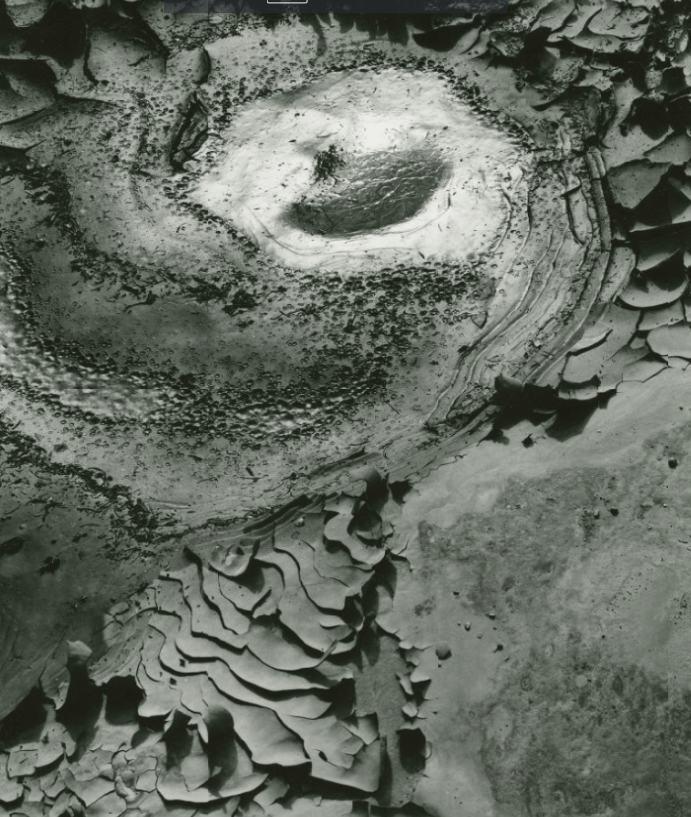
Example 2 – “Sun Spot in Cracked Mud Capitol Reef” Minor White, 1961
First glances at many of Minor White’s images do not always provide answers about what one is looking at. Most of his natural subjects, like this one, are closely cropped and from a very short distance away. The blocking out of perspective and context makes it difficult to place them at first. This one, as the title describes, consists of patterns within cracked mud.
Once we have looked long enough, or been given the right clue, however, White’s work arrives with absolute clarity. Though providing his forms in a way that limits our exposure to them, he nevertheless strives to present them as exactly what they art, in detail and crisp clarity. They are exactly what they are, and it is only our odd placement which make us see them as novel.
It is exactly this forced juxtaposition which makes building a connection with the object more difficult. We see the mud, and understand the mud, but it does not register in the same way. In fact, I would argue that his work is specifically about disconnection. It is about breaking down our preconceptions of the world around us.
So, high level of clarity presenting a high level of disconnection. I would say that this is also a work of significant integrity, but caot be included in quite the same category as the previous work.
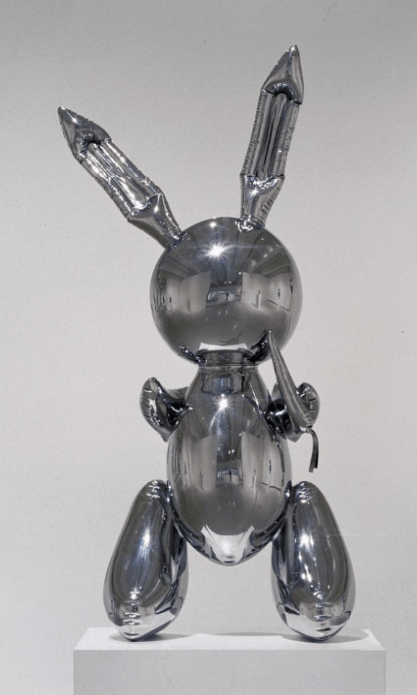
Example 3 – “Rabbit” Jeff Koons, 1986
There are multiple levels of ambiguity and/or deception taking place within this piece. First is the materials themselves. The sculpture is crafted out of stainless steel that has been meticulously crafted and detailed to appear as if it were a helium balloon. This is an intentional blocking of our ability to accurately perceive and understand the piece. There is, however, no secret that it is metal, and the artist has made a name for himself producing many works that follow this type of execution. So, knowing anything about Koons is to potentially be familiar, thus lowering the impact of the artistic deception.
A secondary deception has been called out by others in the art world who feel that Koons also misleads people by presenting himself as a singular artist when in fact he has a large workshop making these sculptures for him. Depending on the viewer this may constitute another level of deception.
Since I have not spent much time studying Koons I will keep my view focused on the deception within the materials, and rate this as Deceptive in its level of clarity.
I come up a bit challenged when I try to place an object within the piece. It certainly isn’t about rabbits or balloons for me. It must be about this deception of materials and a challenge of my own perceptions. Similar to White’s work I see potential that it is trying to disconnect me from what I think I know. I certainly don’t feel more connected to anything while regarding this. Perhaps there is a whiff of anti-capitalism or materialism here as well, both of these are forms of disconnection too.
Because the object of th work seems to be this odd deception of materials, that must actually increase the clarity of the work somewhat. If I am intended to see how this is not a balloon, then can it be called deceptive in trying to trick me in the first place?
A work that aims to disconnect the viewer in a deceptive, but not maliciously deceptive way. Still, playing quite low on the level of integrity.
Example 4 – “The Electrician” Boris Eldagsen*, 2022
Let me start with connection on this one, for reasons that will become clear later. Two women, one older, one younger, probably mother and daughter, appear together. The mother holders her daughter at the shoulders, perhaps comforting, but also gripping, even holding herself up. The younger woman looks ahead perhaps to a mirror, seeming to see her mother’s face in the reflection. Her own look is resigned, tired perhaps, concerned. It can be read as a commentary about a complex relatioship. Something we all share with someone in our lives, especially the experience of being a parent or child, or having the expectations of someone weighing on your in one form or another. There is much content here from which one can read forms of connection. The object is not directly obvious to me, but I seem to be reacting to this nexus of intertwined relationships which bridge me to elements within my own life. This image displays high levels of connectivity for me.
Clarity, though, becomes an issue quickly. The image appears to be a vintage photograph, but there are elements which seem too smoothly rendered, even illustrated.
The truth is, this image was *generated using Dall-E 2, a text to image generator that runs on AI. The artist created this with the intention of entering a photography contest to see i they were “ready for AI”. As he notes after the fact “they are not”.
Eldagsen’s image won first place at the competition, which ceratinly makes for an interesting story, but isn’t the main focus of my attention here.
His intention of entering the contest only highlights for me that he didn’t craft the image for any specific purpose other than it had to be something that might pass for the competition. This is disingenuous in terms of clarity because it signals that no matter what connection or meaning we read within the image, they were not placed thereby the artist as part of their process. These elements are accidents at best.
A secondary complication about AI-generated art is that they occur as output and input. The “how” of being made cannot be known even to the artist. This makes the work both deceptive and opaque in terms of clarity.
So, even with high levels of connection, because they are both opaque and disingenuous, we must read this as a piece of very low integrity.
Doing this experiment already taught me a lot about how the framework might be used. I have some thoughts and further developments, but I would very much like to hear what others think. Is there something useful here? Do you disagree with my readings? Does the system make any sense at all?
More thoughts on what this means for the bigger picture of art discourse are my next project. Perhaps looking at some of the broader applications will help to bring out what I find so intriguing here.
Thank you for taking the time to follow along with me.
The word integrity means moral consistency and commitment, but it also means something whole and unbroken, uninjured, and it’s a quality found in many beautiful things.
I would like to hone that a bit and say that integrity, wherever it is experienced, imparts beauty. Further than that, I think that considering the integrity of a work of art can provide us with useful perspectives on the role art performs within culture.
The root of the word denotes a binding of things together. It signifies a structural connection, a reason for their interacting with one another, a reliance upon the whole for this relation of elements.
To be integrated does not simply mean to belong, but rather to be included, involved, accepted.
Parts of a machine which are integral are the ones which cannot be done without. To lose one means that the system ceases to function as intended.
The root of these words speaks to an interconnection that carries with it a special sort of relationship and meaning. It is a binding of things one to another such that the sum becomes greater than the pieces.
Solnit, at another moment, clarifies the meaning of this word by reminding us that the active opposite occurs within the word disintegration, the thorough separation of constitute parts, the ultimate unbinding of a whole unto absolute destruction.
It is within this context that the word Integrity sharpens. It means moral consistency and commitment, not as static badges earned and worn, but a necessary layer of character that emerges through the binding of other elements of living.
Integrity, as a quality, plays out in time like a song. It can be witnessed in action, or identified by the clues it leaves behind.
I want to explore how integrity is related to art in two ways. Or rather, two spectrums of understanding on which art may fall in relationship to integrity
Language is a bit fragile here and certainly isn’t doing me any favors, so let me try and separate these two spectrums out by introducing two terms by which we can bring the matter into focus.
Connectivity and Clarity. By describing these two aspects of a work of art we can talk about the work’s integrity.
Connectivity is a spectrum relating to what the work of art is attempting to do. Does it seek to connect or separate?
My premise here is that works of art act as interpreters, or perhaps mediators, connecting the viewer to a conceptual object. The art seeks to bring the viewer and object into some sort of juxtaposition.
A landscape may seek to bring the viewer into relationship with nature itself, or man’s mastery thereof, of the feeling that the place invokes, or the history attached to the scene and subject matter.
A portrait might seek simply to introduce the viewer to the person who is depicted, though it might also be seeking to put the viewer into relationship with a more abstract concept of power or fame, or the concept of legacy.
Art need not settle on one object, but it will place the viewer into relation with at least one, or else it cannot be thought of as art.
Building connections is one end of the spectrum, but art can also seek to break them. Some of the most powerful and affecting works aim to challenge our preconceptions, our allegiances and our blinders for the way we imagine the world to be.
Identifying what the work is seeking to do, is one way that we can talk about its integrity. Does it seem to build connections, or break them? This is what I mean when I talk about connectivity.
Clarity.
What a work seeks to do is not always in alignment with how the work came to be, or how it is presented to us. Clarity seeks to place a reference on the origin, formulation, or presentation of the work.
Clarity is whether, and in what form, we have a sense of how the work is. Can we trace it back to the original conception or idea, to the cultural moment or theoretical treatise which sparked it? Can we read into it the seed from which it grew? How has it been presented to us? Do we feel that the true intentions of the piece are in alignment with how it claims to exist?
One way to think about clarity is simply visibility into process. Can we read the brush strokes, as in an old master, or can we actually see the work being created, as in a tik-tok behind the scenes studio video?
Another way to think about clarity is to frame it as genuine as opposed to disingenuous. Or, think of it in terms of ends and means.
Clarity can be read on a spectrum, but exists within three general modes: that which is clear, that which is opaque, and that which is misleading.
What is clear can be traced and understood. It is the detailed, journal notes, the process sketches, the studio shots, the iterations, the artist speaking about their work.
What is opaque is a presentation of a finished product which seems to have no history. It is a final image that seems to spring forth fully formed from the ether. It is, at its most extreme form, the AI generated image which cannot be fully explained even by the artist from whose prompts it was derived.
The disingenuous is that which is purposely obscured, or twisted, to appear as something it is not. It is the Banksy which destroys itself, or the carefully crafted videos of smiling people in pharmaceutical commercials.
Integrity is the assessment of these two axes, clarity and connection. Is the work seeking to build connections and sharing with us where it came from? Or is the work seeking to break connections while being fed to us through filtered social media? Or, as it certainly the case with nearly everything we will encounter, does it exist within a more nuanced threading and shading of these two?
To be clear and to build connections is to have high integrity, and to be the opposite is to display low integrity within this framework. It isn’t one aspect or the other which dominates, however.
In a following post I would like to tease out how this framework might be used to evaluate actual works of art. Then, following on that, I would like to dig deeper into the reasons why such a framework might be important for how we continue to talk about art.
Ultimately, what I would like to propose, is a moral lens for discussing art. A way of looking at art while being able to say with shared language whether a work is acting morally or not within the culture.
Dangerous and slippery ground perhaps, but something I feel is ultimately necessary for the next phase of artmaking and cultural health.
Thanks for muddling through with me on this first stab at describing something I am still finding words for. I look forward to hearing thoughts about where I am heading, and what this might mean for how we encounter and think about art.
EDIT: see the post Reading Integrity in Art for ways in which this framework might be applied to a range of works of art, as well as some further examples of the terminology in us.
I have adjusted the way I hold knife while preparing vegetables. It used to be the case that I would hold the handle with my fingers wrapped all the way around. After all, wasn’t that why the grip had been so ergonomically molded in just such a way?
After spending a couple of months working in a commercial kitchen, however, I quickly adapted to a different grip. Now I hold the knife much higher up, with only my last two fingers curled all of the way around. My index finger, middle finger and thumb clamp the sides of the blade at its base. This provides much more control for angle adjustment, and also prevents the blade from rolling side to side, especially when trying to cut rapidly.
It is a handy adjustment to technique that I continue to use while cooking at home. Part of me realizes that it has practical advantage, and part of me simply enjoys the thoughtfulness of execution. perhaps by sharing this I have introduced someone to a new “kitchen hack” (double meaning unintended), but another way to describe it could be “the art of handling a knife properly”.
The phrase “the art of” shows up regularly as a catchy headline and is often followed with phrases such as “not giving a damn”, or “waking up earlier than everyone else” or “creating long lasting habits”. The image clip below taken from a simple search for the word “art” is a great example.
Some results from the search prompt “art” on Medium, 2/12/2023.
Language is spectacularly tricky. The ways in which multiple meanings can masquerade together under one word lull us into a false sense of understanding. We may find that we have wandered far under certain impressions only to be awoken suddenly to realize that the path we believed we were on has long since disappeared over the horizon.
Art is just such a word. How many miles have we travelled using this word only to find ourselves on opposite ends of the map?
When did it become the case that we associate those who paint, draw, sculpt, design, orchestrate music, write poetry and other forms of the “fine” arts with their output? Why is it that when we think of the use of the word art, it often comes down to this strange split: when talking about capital “A” artists, the word art refers to the output, the thing which has been created.
To talk about “the art of” we are referring to the crafting of something and the process by which one may produce a desired result, rather than the result itself. The art of artists is an output, but the art of an action is the method?
The art of artists is simply what they make. To be an artist is to make pieces of art. To be artistic is to have the capacity to create works of art and perhaps a desire to bring art into the world. To be artful is to execute in a way that demonstrates skill and technique and character, not just in the final product, but in the doing of the thing. The artisanal is that which has been thoughtfully crafted.
This appears to be a divided word. Are we interested in the what, or the how?
A wonderful story of the artful in practice can be found within the third section of chapters of the Chuang Tsu, which is a collection of Taoist writings held in great regard within the canon of religious thinking.
The translation which I have at hand is itself a work of art, translated by Gia-Fu Feng and Jane English, and embellished with calligraphy by the former, and photography from the latter. Though the book has clearly been artfully created, I find myself desiring to use other language to describe it. Rather than leaning on the phrases I have been highlighting I feel drawn to something more like “crafted with love”, curious indeed.
The story goes like this:
“Prince Wen Hui’s cook was carving up an ox. Every touch of his hand, every heave of his shoulder, every step of his foot, every thrust of his knee, with the slicing and parting of the flesh, and the zinging of the knife – all was perfect rhythm, just like the Dance of the Mulberry Grove or a part in the Ching Shou symphony.
Prince Wen Hui remarked, ‘How wonderfully you have mastered your art.'”
There is is on the page. It is in this way that I think we often frame “the art of”; as a skillful wielding of technique. The tips and tricks learned through use of the tool. Certainly we can assume that this butcher knows the proper way to hold his blade.
The butcher has not yet had his say in the matter, and he answers like this:
“A good cook changes his knife once a year because he cuts, while a mediocre cook has to change his every month because he hacks. I’ve had this knife for nineteen years and have cut up thousands of oxen with it, and yet the edge is as if it were fresh from the grindstone.”
Masterful technique indeed.
Appreciation of skill in action is often the only perception we have from the outside. It is an aspect we can point to because it points to an outcome. Through execution of the technique something is achieved, and the reasoning works just as effectively in reverse. Often we, lay people observing someone else’s field of expertise, have no perspective to bring to what we are witnessing except for the outcome achieved. Working backwards from an outcome we can reason that the necessary technique had been in play.
Like watching an episode of Cake Wars we are provided clear perspective on who has accomplished the challenge. No matter how amazing the pastry looks, if the judges do not approve, the lack of skill is apparent.
Skill is just a bar to be crossed. An unassuming cake may taste amazing, and a bungling contestant can ride the brink of kitchen disaster only to pull it off in the end. It is when we see two people achieving the same objective side by side that we suddenly notice which one has the artful approach.
From cakes back to oxen, there is more the butcher has to say. The hardest work is separating the joints and working through tendons and ligaments that connect the great beast into a synchronous animated whole.
“When I come to a difficulty , I size up the joint, look carefully, keep my eyes on what I am doing, and work slowly. Then with a very slight movement of the knife, I cut the whole ox wide open. It falls apart like a clod of earth crumbling to the ground.”
Or a dropped cake perhaps.
Where, when and how exactly to apply technique. Artfulness as discretion. As decision-making.
Our word for making decisions comes from a linguistic heritage which means “to cut”. For when something has been cut there is no returning to the way that it used to be. The rope is severed, the bridge falls, the cake collapses and the ox crumbles.
And from now on I will substitute “ox” for “cookie” when I shrug and remind myself that is simply how things go sometimes.
If artfulness, the art of something, has more to do with how we choose to execute it, then we place ourselves into a curious relationship with art, craft and trade.
Suggesting that “fine” art has more to do with the output, the finished piece, is perhaps to remove it from being “artfully” done. How can that be the case? Can a masterwork be pulled off on a wing and a prayer or a hail Mary pass? Do we want to imagine that the artifacts we value so highly were created thoughtlessly?
This may pose issues for the non-representational artists, the abstract expressionists, the automatic painters and those who create interactive works.
Or are the decisions being made in the preparation, the parameters that bound the work?
Artfulness, while perhaps a stranger to the capital “A” artists becomes friend to the tradesperson, the craftsperson and the hobbyist. For those are the ones whose work is focused within the overlap between technique and judgement. The art of table-making, plumbing, graphic design, heart surgery
Do we live in this polarized world of art making? In which one group, hailed as champions and creators of culture, are only judged on what they make and now how. While the majority hone their art day in and out without recognition for their artistic achievements?
Leonardo da Vinci, in his extensive notes, describes the artists’ special ability of composition as the ability to hold the potential image within one’s mind. He describes an understanding of what one wants to paint that is built up on experience and study. One uses experience and skill to imagine any possible variation of the image before it comes into being. This is the technique.
The real skill is in the choosing which variation to execute. With enough experience and study the artist should have limitless options from which to choose, but it is the decision which defines the art.
Not unlike AI, which can generate images of whatever we wish, and stands in for our individual experience and technique, it nevertheless cannot replace the true act of art making: the final determination of what “should” be created.
Making art becomes synonymous with making choices. Liberated from the challenges of technique, we must still accept ownership of our decision.
The word acts as a one-way mirror.
From the outside we can only speculate about the forces at play within the moment. it is through the demeanor, the flow, the theater of execution that we infer art at work.
From within we understand the choices we are making, the skills being tested in each moment. It is in the odd juxtaposition of our efforts and the outcome which has been birthed that we struggle to accept the art at our fingertips.
Perhaps the word is not quite so divided. Perhaps it is simply that we ourselves are divided, and the word reflects what we bring to it.
To accept that our output must stand on its own, and that our own efforts will mostly go unrecognized, is to begin to see the art in everything. From crafting a masterwork, to sweeping the floor.
What a world to live in, where each of us can be an artist moment to moment.
Perhaps it is best to let the butcher have a final word in the matter.
After reducing his oxen to a crumbled clod of earth, “I stand there with the knife in my hand, looking about me with a feeling of accomplishment and delight. Then I wipe the knife clean and put it away.”
A good time to accept my own conclusion, wipe my pen off and put it away. Best to leave the last word to the man with a knife.
I have been fascinated by Emmanuel Kant’s description of aesthetic knowledge and the nature of “beauty” as outlined in his Critique of Judgement. He weaves a tight net of deduction and reasoning based on empirical understanding of the world and logical conditioning. His extrapolation on the quality of beauty itself touches on truths which are by their nature beyond words. In order to begin to describe the nature of beauty he first works to outline aesthetic knowledge.
This type of knowledge is essentially our experience of something as it arises within us before we are able to formulate analytical judgements. It is the physical and emotional things that we feel when we first encounter the world, and before we can begin to formulate words to describe it. These are visceral perceptions of our world that bring us a special sort of understanding and sense of our surroundings that is not mediated by words or rational thoughts.
Beauty, for him, is an aesthetic judgement which occurs within us as we encounter something outside of our selves in a way that transcends words. Or, more often, before those words kick in and begin to shape our experience.
This framing of beauty is something that we can only truly judge from within a wordless context or pure experience. Kant reserves much of his highest praise for nature, and works that share in the spirit of nature. To try and describe it more fully he outlines a quality of nature which he calls the “purpossiveness”. This is to be understood as as sort of self-organization or drive, or foundational quality. The attribute of being the way it is because being that is the way that fulfills its own purpose. The way that each element of a plant or animal has been crafted to support the sort of existence it requires within the context in which it lives, its ecosystem and biosphere.
That a blade of grass is the shape, color and texture which it is, is because that is the way that it needed to be given the resources it had and the environmental elements it was dealing with. There is nothing about the form of the grass, the experience of the grass, which doesn’t need to be there and isn’t linked back to its essential character.
That, for Kant, is something which can be said to be beautiful.
That word, however, that description, falls into the realm of rational thought and rational judgements. It isn’t an aesthetic judgment in and of itself. In fact, it is impossible to put an aesthetic judgement into words at all.
Beauty isn’t an attribute, it is an experience. It is placing oneself in relation to something in the world which is true to its own nature.
Finding aspects of our world which adhere to their own natures is actually very easy. Any natural element, from weeds in the sidewalk to rain puddles, to cracks in the cement are the way are given the context and innate attributes of how they came to be. These things cannot be other than how they are, and will always be fully what they are in this moment.
The difficult part of encountering beauty, then, isn’t finding things which are worthy to described that way, it is placing ourselves into an orientation to experience them as beautiful.
When we see a marvelous mountain, snow-capped against the blue sky and the deep shadowed valleys, that great grandeur and majesty absorb us completely; for a moment we are completely silent because its majesty takes us over, we forget ourselves. Beauty is where ‘you’ are not. The essence of beauty is the absence of the self.
Words are the end of beauty, because as soon as we start trying to capture what we see in words we have ceased experiencing it in an aesthetic manner.
It is natural to document and describe the experiences that we have. There is value in passing on those descriptions to other people. There is nothing wrong with formulating arguments for why one does or does not appreciate a work of art, or a tree.
Those classifications, delineations and descriptions are not, however, beauty. Beauty belongs to each individual and only in relation to what they are having an experience with. Beauty isn’t a universal standard which can be tracked or passed from one person to the next.
Beauty hits us not in the consciousness but in the body. Think about a piece of music that gave you goose bumps, or standing in front of a work of art which literally took your breath away. Those expressions tap into the visceral experience that we all have had at one time or another. Whether or not we would describe that experience, that object we are encountering, as “beautiful”, the experience itself is the experience of a kind of beauty.
Kant would probably not have said this the way that I am, and certainly may have disagreed with much of this. However, based on how he has described the mechanism and orientation of aesthetic judgement, I can only arrive at these conclusions about the nature of what is beauty.
While we are surrounded by the potential for experiencing beauty all the time, we are prevented from it through the constant need to document, describe and rationalize everything which comes before us. Our ego, ever focused on self preservation in an increasingly complicated world, does not let down our guard long enough for us to simply be open to what is around us. Tuning ourselves towards greater awareness and mindfulness is helpful to allow distance between the ego and our perceptions of the world.
Beauty, finally, isn’t the elusive and rare quality to be sought out and prized within a handful of objects. It is possible to have an experience of the beautiful with the aspects of our world which are already around us in each moment.
The barrier to this experience is within ourselves. The ego, ever watchful protector of the “self”, judges the world in terms of usefulness and threat. Through ego we treat the world around us as either something to be used, something to be avoided, or unimportant.
It is only when we are feeling secure, satisfied, comfortable, loved, supported…that we are able to let down our guard and experience what is happening around us with greater perspective. In this mindset we are open to being more compassionate and supportive of others, and to seeing things for what they are.
An interesting additional benefit to cultivating mindfulness is that we are only able to experience moments of beauty when we are in a space to see our world the way it really is, and not the way that our ego categorizes it.
Mindfulness is certainly having a moment, thankfully, and for many excellent reasons. Add to this list the ability to leave your door open to beauty. Sink into the aesthetic knowledge of the world, the inherent purposiveness of the natural world especially, and you have the opportunity to be surrounded in a sea of beautiful encounters. Just leave the ego at the trailhead.





 Wandering Path Arts