What is Wisdom?

Can you explain complex ideas without using jargon or technical terms? Can you give someone a clear idea of what you mean in less than two sentences? I just had a masterclass in breaking down ideas to their core elements while playing a game with my six year old daughter.

The game “Oh Really” is a fascinating social experiment in which five cards are selected each round and players have to rank them in terms of most to least important. The content of the cards varies wildly from seemingly simple things like “teeth” or “heat”, to more abstract ideas like “patriotism”, “faith” or “wisdom”.

It is great fun to choose someone as the focus person for each round, and then all of the players try to guess how that person will rank whatever elements are drawn. While the most humorous elements occur when someone is trying to passionately explain why they think that “haircuts” are more important than “freedom of speech” (I mean, if you didn’t have haircuts then we would all just be incredibly shaggy!), what I found most fascinating and challenging was actually what happened before each round really got started.

As he placed each of the five cards for the round on the table, we had to run them by my six year old to make sure she knew what we were working with.

Here is the challenge that I came up against: how to describe some of these things simply, clearly, and in as few words as possible. Too much qualification, too many terms, and suddenly the description becomes top-heavy, awkward and anything but clear.

Sure, I can begin a long tirade about “wisdom” (which I did) and talk about philosophy and mysticism and experience and practice and having an innate sense of moral good, etc…but I have already lost myself. The need to qualify, to add another facet or flavor to round out the picture, these are things that point out just how little we actually grasp what we are talking about.

Enlightenment thinking and the purity of rational thought is about breaking down and defining everything until it fits neatly in a box. So much of the philosophical canon is simply people trying to tease out slight difference between theories. Certainly, there are implication about the mechanics of things, and whether qualities inhere in something as opposed to simply being projected onto them, for instance. In most cases, however, these nitpicking points don’t actually offer us a branch to hold on to. When we are living our lives, these nuances don’t often have an influence on the way we actually encounter the world.

Take, for instance, Zeno’s paradox. An archer stands at one side of the colosseum and fires and arrow at a target which stands across the space. Zeno states a simple logical fact which seems to lead to a paradox. He states that in order for the arrow to arrive at the target, it must first cross half of the remaining distance. Then, it must cross half of the remaining distance again. This halving continues. As there is always an amount of distance to be covered, and it is possible to always measure half of that distance, the loop seems to go on into infinity. The arrow can never reach the target because it must continue to cross half the remaining distance and infinite number of times. Even if the time required to do this is infinitesimally small, it is still an infinite amount of time, and therefore can never be achieved.

Of course this is absurd, hence the paradox, of what we can puzzle out about how we expect the world works and the bald reality of how it actually operates. So often our philosophy seems to be wrapped up in the way the paradox is written rather than accounting for what the arrow actually seems to do as it clearly crosses the space in a smooth and unhindered arc.

I believe that for many thinkers, perhaps due to the postmodern penchant for dismantling any and every postulate, there is an overabundance of caution for how one states a belief or a theory.

After my game had ended I continued to think about how I could have defined “wisdom” in a more concise way.

The best I have come up with is this: “Wisdom is the kind of stuff you know about life from having lived it, instead of reading about it in a book.”

Immediately the alarm bells start going off, and I want to clarify and add nuance, but then I feel like maybe I should stop myself.

It feels vulnerable to leave such a simple statement hanging out in the open, but I think I can stand by it. The longer it sits, the more I press and prod, the more comfortable I become.

My need to define and qualify everything is probably just insecurity coming through. It takes a kind of guts to state something with clarity, knowing that there will be questions, and “what ifs” and other kinds of challenges. Perhaps the insecurity is about my ability to answer those questions appropriately.

I think that this is an excellent exercise to try out on things we think we know.

Having to explain “generosity” and “politics” and “responsability” means clarifying it for ourselves.

There is a second reason that this is so important. The ability to present these ideas clearly, concisely, is a point of entry for others. My being able to explain “wisdom” to my kid gives her a frame of reference and an entry point. It puts the concept on her mental map, which gives her a destination to explore if she so chooses.

One of the things I find most frustrating about philosophy, and other academic fields, is that they are often presented in such a way that one feels unqualified to even begin to understand. The barrier to entry seems too high for many people who encounter these ideas without a knowledge of the context or the terminology. Even to build a knowledge of that terminology often requires a canon of historical and contextual knowledge. What might it look like if more people felt that they had footing to approach these concepts? What sort of insights would we be able to gain from those who chose paths other than the academic, but have still gained knowledge that bears sharing in the same conversation?

Try it out for yourself. Can you break down the concepts which you find more intriguing, which matter the most to you, into a simple phrase without jargon? How does it feel?

I may not be able to back much of this up with citation, but it is definitely something I have come to learn from my time living as opposed to what I have been reading in books.

The Once and Future Echoes of My Father’s Words

Grief and loss impact a life as a projectile. Often it is the impact which we notice the most; jarring, often spectacular, and difficult to look away from. More difficult to perceive is how our trajectories have been affected. Upon rebalancing our daily lives, more or less retaining a sense of equilibrium, we may never come to grasp how significant the change to our wider orbit.

The movement of celestial bodies, we often forget, occur in a complex three dimensional space. It is easier to imagine rings of movement occuring upon a plane of existence. Human lives also travel more complex paths than we are able to envision. For me, the impact of my father’s untimely death, ahead of a time of my life that was already poised as a pivotal transition, served to deflect the wide plane of my life’s orbit. Instead of traversing amongst others in what I imagined to be the normalized circumfrence of life, I found myself slipping below the plane of normalcy.

This perspective, traced out over my lengthening arc, has been forever tinted by our truncated relationship. His words and our time together continue to stand for me as ruins and echoes littered throughout the landscape. Within the dimensionality of our circuits I am beginning to see that traditional perspectives of “above” and “below” are interchangeable. Ruins may spark longing for the golden ages of times past, but they also, as incomplete potentialities, speak to a developing future. In this way they act as mile markers staked out upon the road ahead, shining in the dark, tiny lighthouses beckoning from the misty unknown future.

Eldena, 1824, Caspar David Friedrich

These thoughts intertwine with my current studies of art history. I am researching ruins and fragments as they appear in Romantic era visual arts. The example here, by Caspar David Friedrich, echoes on more than one level.

His work, however else it might have developed out of his natural inclinations for art making, would be forever sloughed off course by the death of his brother. An event on a frozen lake in which he also nearly drowned, but was saved, while his brother was not.

Many of Friedrich’s pieces relate what appears to be a struggle between structures and institutions which have been created by man, and a relentless overgrowth of wild nature. The struggle, really, isn’t depicted as it takes place. Rather, it is always depicted after the fact, once nature has reclaimed its spaces. Human structures in ruin provide support for the overgrowth, their former architectural duties having been long neglected.

Lives coexist in a shared space along divergent trajectories. In one view the human lives unfold presently, quietly, small figures unobtrusively going about their existences both comfortable within and oblivious to both the wild nature and the encompassing ruins which tower around them. The existence one leads in the current moment of perception, myopic to past and future, necessarily concerned with the previous and forthcoming footfall.

In another version of reality the past looms ever present, indeed framing, the happenings of the now. These figures, though blithe to the fragmented walls and broken arches, nevertheless exist within this windbreak. The moment unfolds according to a constructed history that beckons ever backwards. Shadows of what once were linger over each moment of the present.

My father was a man who knew how to listen. He appreciated a good story and would make himself open to receiving one when it presented itself. His words did not go before him, but always seemed to come after. His imagination slumbered with one eye open, waiting patiently for nourishment to arrive, ever ready.

His story was not kept behind locked doors, but he waited for an invitation in order to begin telling it. Without the right question he was not inclined to explain himself. About stories, however, he was often eager to share. To hear him offer up a bit of plot was to uncover a thread of excitement. It was by gathering these threads that I came to an understanding of who he was.

In the manner of detecting exotic particles, unable to observe the phenomenon itself, I learned what I could by watching how he interacted with stories.

The crumbling ruins of my past portray him seated in his recliner, book in hand, absorbed in ideas of the novel and fantastic. Fragments of him lay embedded in the soil around me, of a look or gesture, a secondary clue as to what his mind was engaged with. In many ways, while those elements remain as ruins of ruins in my landscape today, they were already ruins. I learned how to read these ruins even as they were being created, rubbing the patterns and documenting the dimensions of his life in order to build a model of the man even while he lived.

Returning to Friedrich’s depiction of ruins we see a third layer of existence beyond the realm of man. Each part of the image, man at present and man of history, are engulfed in the wild living and entangled reality of untamed growth. Nature itself writes and flows in a quantum state of superposition. Observe any detail of the work, a branch or leaf, and it can be made out in detail, static, unchanging. To focus here, however, is to lose focus there. Any point in the image which we are not currently paying attention to grows unchecked, flows, writhes, pushes its boundaries and moves towards its own realization.

The plants are everywhere and eternal. This growth exists equally in all times. To cut down the trees and raze the fields is not to eliminate them. It is merely an ebb in the tides of existence. Now the plants are dominant, now subdued, now expanding now cut back. The taproot, the eternal seed, exists outside of time, connecting our separate realities to an unchanging axis.

In the excavation I was doing on my father’s character I covered more territory than I understood. It wasn’t the content of his words that caught my memory. Indeed, though it rolls heavily off of my tongue to say it, I do not recall him in specifics. I recall him as a framework, perhaps, or a model, a flowchart. Place the input at one end and track the process by which one arrives at a result. To know him in this way was to understand something about what provided him meaning.

Crucially he demonstrated to me that there was meaning between us. My words, my thoughts, my imagination matter to him. The machine churned and the pistons fired and I had a sense of knowing beyond the face value of human communication. I could see the mechanism deriving fuel from content I had created, and it felt like touching the sun. Like something real.

I have always hung some significant portion of myself upon the hooks provided by others. My father has unconsciously left hooks for me upon his ruins. Rather than mourn the structures that once existed, I am coming to realize that they are still able to serve a purpose in my noon-time journey. Whether that be shelter from the barren landscape, or sun-dial markers upon which to orient myself, these ruins maintain their presence.

For romantic painters, writers, musicians and thinkers of the time period, ruins could no only exist in the past and the present. Melancholy crucially combines longing for the past with a desire for the future. To see something that once was is a stark depiction of change. Layered history necessarily leaves open an undefined future state.

To restore a ruin is not to resurrect it. Each stone may sit where it used to reside in relation to all of the others, but that does not mean that they retain a similar relationship to us. A building is only as meaningful as our collective understanding. Place the disparate branches and leaves of a fallen tree back in relation to one another and there will not suddenly be a return to form. No animating faculty continues as it once did, not in the same pattern.

A study in ruins as symbols of greatness reveals the relationships that we once had with place and space. To understand the function of a ruin as it was, and how it came to be what it is now, is to understand the continuity of activity which provides it with unique energy. Like the wild growth all around, which follows an internal unfolding, so may we place the fragments which surround is in relation to the future.

I hear stories now as my father heard them. I too slumber with one eye open for the things which my curiosity seeks to entrap. My father’s model overlays like augmented reality across my vision.

Above and below the nominal plane of existence I see these fragments and ruins intersecting our space. They carry me forward from within, and stake safe passage on the path ahead of me. I triangulate my position by looking simultaneously backwards and forwards from these points to map out a narrative which encompasses the life he lived and the paths he may have taken if given the chance. His loss bound me to these ruins, perhaps less like a projectile and more like a hewing together of sympathetic trajectories. Had he continued to live it would have been simple to draw a distinction between the path he charted and my own. Since that is not the case, to chart his future journeys and separate them from the paths that I walk will always be impossible. I do know that without these milestones and lights in the fog, my path forward would not have been possible in the same what that is has been.

To Remain Silent / the Worth of What we Create

When the pressing need to keep talking overrides the vital perspective that what one has to say isn’t worth saying, or, that saying something just for the sake of saying something is less educational than knowing when to keep quiet.

The old saying: “if you don’t have something kind to say, don’t say anything at all” ties in to this, but I don’t mean this to be about kindness.

Another linked idea is “art for arts sake”, which in this case should be more accurately stated “art for the sake of the artist”. How many artists out there are making things because NOT making things feels like failure? How many of us are filling the void with acts of creation? How much of humanity at large has been about bringing things into existence simply because it makes us feel less alone? Because the act of creation feels like an accomplishment, feels like a clear mark of achievement? This is at least partially about developing taste, the discernment required to understand the worth of what we are putting out into the world. To be able to make use of our creations as stepping stones towards our ultimate purpose.

I must be speaking from a narrow pocket of reality here. I must be one of the few artists whose creativity has been put to use for internal purposes, to explore my relationship to the world in which I find myself. In that regard, the purpose of my art can be analyzed apart from the market and the world of the consumer. For many other artists, the act of creation is the end goal, is their livlihood. To create is to live. They are making art which they enjoy for the use of others. There are no deeper questions here, no barometer for philosophical growth.

Does that excuse us, or alter the frame? What of the engineers and inventors, the food scientists and writers? Is the act of creation always a worthy end in itself? Or, should we consider the cradle-to-grave implications of anything we hope to call into being? Can we reframe our unique nature as creative beings to include increased discernment? What would it mean to only call into being that which passes layered levels of vetting, perhaps moral, aesthetic and philosophical?

Is this a saving grace of the looming meta, to give us a place in which our creations can flourish apart from “real world” impact? Of course there is still a footprint, but beyond that, in a purely zero-impact world, is there reason to consider why we feel the need to create and what purpose it serves? Is there potentially fruitful ground to cover when considering our sense of taste? Do we really know what questions we are trying to answer? Do we really know what avenues to pursue? Will the work we are following deliver us closer to our goal, or is it being subverted in service of someone else’s expectations?

If we aren’t creating, even if we are continuing to learn and grown and mentally “pursue”, can we still call ourselves artists? Do we need to adjust this term to separate those who produce work, from those who are merely seekers or philosophers?

James Elkins is a professor of Art theory, criticism and history at the School of Art Institute Chicago. He is a fascinating writer who has spent a good portion of his time exploring what it means to teach art including art theory and history. He is by no means fully on board with the way in which art is taught, and offers up some very interesting critiques about the state of art education, including the way critiques are conducted. Much of his writing is available from his website.

Along with the literary work he has provided for free, he has also made available a wonderful collection of youtube videos comprising a survey of key topics in art theory and art history. Watching these vidoes, each of which is generally about 20 minutes long, is essentially to attend lectures for an introductory survey class. The intention of this series is to provide general introduction for artists so that they can identify potential areas of interest and study which might inform their work.

Each video is categorized as either a theory or history video along with clear topic, so it is easy to find any topics that one might be interested in. Along with providing a solid background of where the ideas tend and originated, he does a great job highlighting developments of thought while providing resources and authors who might be useful to investigate further.

James Elkins – Concepts and Problems in Visual Art video series.

In the course of his series he takes time during video C28 to consider whether or not it is helpful, or desirable, for artists to study these theories at all. In the course of encapsulating his thoughts he presents two slides which summarize why it might be that students should avoid learning theory (or history). The slides below were taken from his video.

I found myself surprisingly indignant as he outlined these points. Though he does add some more context with his voiceover for these slides, the general bullets stand by themselves.

Without going into each one in detail I would like to highlight how they seem to fall into a couple of broad categories.

The last argument about learning history, and the first argument against learning theory both bring up the idea that when we are exposed to novel information, we run into the danger of being side-tracked by that discovery. Like falling down a wikipedia hole into the MCU, the multiple dimensions of art theory and the ever proliferating array of art movements already comprise too much academic information for anyone to meaningfully take in. As professor Elkins notes it can take a significant amount of study time for any student to get a solid grasp upon the core theory with which they feel their own work is trying to engage.

Perhaps a bit like someone learning a new language can’t be expected to read novels or write letters right out of the gate, an art student who sees potential in engaging with gender theory, post-modern aesthetics or questions of identity probably won’t feel confident creating work that expresses itself effectively in those areas until they have deepened their connection to the context.

Don’t we want those who are engaged with crafting our shared culture to do so mindfully? Don’t we want students who have spent time thinking about the ideas and work of other artists who have come before?

Elkin’s main fears for this point seem to be that diving into these vast subjects will take the artist away from the studio. It may sidetrack them from the creation of their own works.

Is time spent in the studio the best way for artists to discover themselves? It seems to be the general thought. University art departments, while often requiring the general education requirements for other degrees, still provide a silo of studio work time as the backbone. Art institutes, like the one Professor Elkin’s teaches at, provide even less extra-disciplinary experience for the artist to draw on. There is a lot to be said for becoming a master of the material, and for learning everything that it can and cannot do. I might argue, however, that the most interesting growth in any area comes when one must step beyond the traditional boundaries.

Which brings me back around to my initial questions. Is creating work for the sake of creating work a good end in itself? Is creating work even the best or most effective way to discover oneself, or one’s voice?

In an age of humanity that threatens to drown itself within its own creations, is there value in remaining silent? Is there honor in spending a lifetime crafting one piece, rather than hundreds of half-formed ideas? Can this be fulfilling or sustainable? Would anyone still call themselves an artist?

I don’t have answers to any of this, but these thoughts have been rattling me.

Slow Wisdom

Knowledge and understanding about our world come to us in many forms. Most often we learn new information through the fastest methods, which are words and demonstrations. Reading the description of a thing is often not as helpful as seeing someone else do that thing, and combining the two can give us a pretty good impression about what we want to know.

Humans, as creative colliders, use what we “know” to iterate new ideas into existence. When we learn new things we give ourselves more options from which to pull when combining ideas. What we “know”, however, and the reason I am putting it into quotes, is often the most basic version of information about a thing.

Words and demonstrations can only teach us so much. It is often quite a different thing to actually put what we think we know into practice. Take woodworking, for instance, in which I can watch a training video about how to turn wood on a lathe, and receive a very solid perspective on the steps and techniques required to accomplish what I need.

I could even transmit this knowledge to someone else as I have heard it, or throw it together with something new. If this how one turns wood on a lathes, then it seems reasonable that the same technique could be used to for turning other similar materials.

As soon as I attempt to put this knowledge into use, however, the limitations of that information come into full force. Even if I use the exact same materials and tools my demonstration, the actual feel of the materials and how it reacts, the muscle quality needed or the steadiness of the hand, the information about how imperfections in the material affect the process…all of these come into play and demonstrate how limited my perspective was.

This is certainly not to decry learning new things from videos, it is mostly to point out that truly understanding something, and truly “knowing” about something comes only through time spent doing that thing. This is because so much of what we call knowledge actually comes to us through our bodies. Through the memories we develop about how we handled previous versions of this activity. True knowledge lives not just in our minds but in our bones and muscles and nervous systems.

This is a large part of the reason why many trades required apprenticeship and hours or repetition. Only through actually performing the act over and over can one develop a broad understanding of what is going on, not just in the mind, but in the body as well.

What does it mean that humans are eager and clever and pass on information so readily through the simplest method possible? It means that we like shiny new things and have a short attention span. It means that we are eager to take new information, combine it into something (or take from it assumptions based on our beliefs) and then spread that second iteration out into the world.

Working in my current job, which is a painting shop environment requiring manual labor, I have come to see how my initial impressions are often misguided or flat out wrong. When I approach something new I develop many perspectives immediately, and part of my job is to think about ways to improve and adapt these processes by thinking of new solutions or adaptations. I often find myself suspending those initial ideas once I have begun actually practicing the process. Often, in fact, every time that I think I understand how to make something better, I discover after putting in more hands on time with the situation that there were factors in play which I wouldn’t have thought to take into account.

The process of gaining first hand knowledge over time through practice might rightly be called wisdom. In fact, that is probably my favorite definition of the term I have come across.

Many situations in which we initially perceived “problems” are the way they are due to other factors, often ingrained in the nature of the system itself. It is only our surface level understanding which has led us to making assumptions.

Trying to leap in and “solve” “problems” without having put in hours of hands on experience no only leads to solutions which do not actually solve the issue, or leads to a whole host of new problems.

In my experience I have been shown many times that the “problem” I am encountering and trying to “fix” is actually a feature of the product I am working with.

As a painter I am constantly playing with different materials, substrates and colors. Many of these designs have been developed by people who have gone before me, and it has been my job to figure out how they did what they did so that our shop can continue to make those designs more consistently or better than before. What often starts out in my mind as the “problem” which we are having with the design slowly becomes the core element of the design. Instead of trying to remove the obstacle I begin trying to figure out how we can use that nature of the design and better incorporate it.

Without hands on experience in our world we are simply lacking depth of perspective, and there are several problems that come along with that. The first one, as already stated, is that we often end up “fixing” a “problem” that didn’t really exist, and that fix often causes more problems down the line.

Another interesting aspect of gaining wisdom, is that it is a process of relationship between yourself and something else. All of the materials in the world around us are the way they are because of the unique forces and events which went into shaping them. The unbelievable complexity of our living world is what leads to the need for this slow wisdom, this building up of a relationship with materials over time.

What does this mean for the digital world which we are building? If everything programmed has developed from human thought processes, then does it have any of the inherent complexity found in natural objects? Can one develop the same kind of hands on wisdom about spreadsheets or social media feeds? Certainly one can gain more skills, but it isn’t as if these programs have their own nature, they are simply following a program. It doesn’t feel to me like learning the nuances of a program, no matter how complex, will ever be the same as gaining wisdom about physical materials, social interactions, or forces of nature. Kandinsky, along with a slew of other philosphers, poets, writers and artists, noted the way we perceive some things in our world as adhering to their own inner nature, an internal necessity, a sense of having a “soul” or some kind of sovereignty in our world as being uniquely unto themselves.

I would argue that the need to gain hands on wisdom from our world is due to this internal necessity which exists in everything around us. It is the inherently alien nature of our world, the inhuman element, which piques our interest and curiosity, and which can teach us the most about how we can be a part of this world.

A digital life, derived from our human perspectives, can necessarily not reach beyond them. Humans cannot create anything inhuman with its own “soul” and sovereignty, yet. Without that, what are we able to learn from the meta world we are building? Aren’t we simply looking inwards, shielding ourselves from the inhuman perspective?

The final point which I would like to bring up about slow wisdom, is that these hands on encounters with our world are often challenging, as well as educational. We are an adaptive species, and our history has been one of learning how to continue on in the face of constant change and external pressure. At least, that is what it had been for most of our existence.

Now, however, we have developed so many tools for altering the world around us in order to suit our preferred living style, we seem to have shifted the focus of our adaptation. Now, we are focused quickly on identifying things which are no ideal, which stick out as opportunities to make things better. Our work is put into shaping our world, in shaving off the rough bits which cause us discomfort.

As I noted before, my work has shown me that my initial reactions are often wrong. Shown me that the things I wanted to “fix” at first are actually the valuable bits. In most cases the solution is not to change the thing I am working on, but to change myself, and my perspective. Instead of manipulating the material I learn how to work with it, or around it, which often means adjusting the usual way I approach things.

Adaptation used to be this way, as our only recourse. It used to be that we spent our energies learning how to shape ourselves, to work on ourselves, to reorient ourselves. We had no power over the world. I am pretty convinced that what the wisdom traditions like Buddhism, Taoism, Stoicism and the new mindfulness movements and yoga studios are trying to help us to do exactly this: to relearn the power of transforming ourselves rather than the world around us.

Original Sin and the Artist

“All means are sinful if they did not spring from the source of internal necessity”

Wassily Kandinsky, Concerning the Spiritual in Art, 1912, p.176

In my search for interconnecting roads between art history, abstraction, spirituality, philosophy and art theory, I have come across a shrine hidden in plain view. Wassily Kandinsky, often cited as the first true “abstract” artist, wrote a seminal work at the beginning of the twentieth century which dives deep into the heart of pretty much everything. It is titled Concerning the Spiritual in Art and can easily be found in translation.

Aside from lucid predictions for the direction of art which have largely come to pass, he also outlines key language and concepts for dissecting and and talking about visual art. There is much here for the artist, art historian and philosopher. I would also argue, and plan to dig into with future posts, that this is also a work of profound spirituality.

What I want to draw out here is something which he couches in religious terms and can be useful in discussing artistic vision, style or voice.

Kandinsky believed that each artist must honor the internal necessity of each work the is created. This concept is to describe the unique expression of the piece as created through the relationships of color and form to each individual element and those elements to the whole. What a work of art ultimately says to the viewer is very complex, and will change over time. It will be affected by the culture in which it is produced, by the culture at the time it is being viewed, by what has gone before and what has come after, and the internal orientations and contextual baggage of the viewer.

All of this is to say that the artist can never be in control of how the work will be perceived by any other person. This is true as soon as the piece is finished, and remains true throughout all periods of time. There is no way for an artist to express the specificity of their internal view with a 1:1 translation. No matter how carefully we try to game out the relationships of form and color, or pay attention to the undertones of the cultural zeitgeist, our art will at best be an resonant echo of the idea we are trying to convey. As time goes on even a clear echo will fade and gain distortions.

We shouldn’t think this as a failure of the artist either. Kandinsky was clear about the underlaying theory about how form and color interacted. He was very interested in gaming out the relationships between elements on a canvas, and he advocated for the artist to be aware of these relationships. There is a science beneath it all, he would argue, which could be used to describe how the pieces of a work came together to provide meaning, or music. He found it very useful to describe visual elements in terms of musical elements. As he notes below, the form and color of a painting are what produces its sounds, harmonies and dissonances.

“…the same form always produces the same sound under the same conditions. Only the conditions always differ.”

Kandinsky, p. 170

The carpet moves out from under us even as we splash paint on the canvas.

The act of creation itself holds the key. Art, for Kandinsky, isn’t about the final product per se, but the act of expression, the coming into being of the work. The artists charge is to channel what it is they resonate with out into the world. That act, while it will necessarily take shape and ultimately be described in the language of forms and colors, must adhere to its own nature as a unique work.

When he speaks of “internal necessity” he is describing the unique character of a given work or art. Seeing it once completed, and through the lenses of our own time and place, we have to talk about it by describing what we can see. We can break down each piece into artistic school or movement, and describe it in terms of the social situation under which it was created. We can talk about influences on the artist, training and places that the artist travelled. We do these things and categorize works because it is all that is available to us. We, who did not create the work, are forced to look on from the outside like examining a crime scene. These elements have their uses and can provide their own insights which are valuable, but they are not themselves the character of the work of art. Just as a collection of anecdotes, a eulogy and an obituary are not a person who used to live and breath.

The artist is not bounded by these forensic tools when making the art in the first place. For an art student to learn from those who came before is one thing. It is very useful to understand how colors mix, how certain optical effects are achieved, and how similar visual problems have been solved. To copy those techniques in the hopes of achieving one’s own vision, however, is a fool’s errand. Again, Kandinsky talks about the sound of a piece of art. When we are trying to capture something that another artist has tapped into before us, we should be cautious of doing it in the way that they did it:

“…it is perhaps easier to achieve expression of the same sound by the use of different forms than by the repetition of the same form: a really exact repetition lies beyond the bounds of possibility.”

Kandinsky, p.170

Rather, he urges each artist to follow the unique thread of each piece. Instead of painting in the method of one’s teacher, an artist should follow the pull of the work of art itself that wants to be created. This will likely mean breaking from what has been done and trying something new.

“The artist should be blind to ‘accepted’ or ‘unaccepted’ form, deaf to the precepts and demands of his time. His eyes should always be directed towards his own inner life, and his ears turned to the voice of internal necessity. Then he will seize upon all permitted means and just as easily upon all forbidden means.”

Kandinsky, p.175-76

This brings us to our sins as artists. Rather than listening to our own ideas and the pull of the work as it struggles into being, we often try to wrestle it through the art that has come before. Here we are again, with the expanded version of the quote at the top of this article:

“All means are moral if they are internally necessary. All means are sinful if they did not spring from the source of internal necessity.”

Kandinsky, p.176

This may come from a place of fear, or insecurity. It may come from a lack of modelling and role models. For Kandinsky this version of sin is black and white but fluid. There are many reasons why a piece was not realized into the fullness of its being. Often this is because the artist has not had enough exposure to the appropriate ideas, or has not been shown what other avenues are possible.

In this way the sin of the artist is not a brand to be worn in shame, but a continual struggle which should push us to continually get closer. Like catholic original sin, I would argue, it is less the condition of being doomed from the beginning, and more the ongoing charge towards which we strive.

It is in the making of the art, the expressing what is already contained within the concept as it exists within each artist, that we are able to come into contact with creation and expression itself. Every piece is a new chance to come into contact with something greater than ourselves, and to learn something about that relationship.

To focus on the end result, the perception of our work, and our place in history, is to be caught up in a losing game. To try and grab hold of the river as it flows by, or to stop its progress by throwing masterpiece-anchors into the waves, is fruitless. It is a lesson in frustration.

If we can embrace the act of making and follow the unique threads of creativity which pull at us, then we can appreciate that this process is what is valuable. To be in touch with one’s own creativity, I would argue, is an irreplaceable blessing.

“And we see the common relationship between works of art, which is not weathered by the passage of millennia, but is increasingly strengthened, does not lie in the exterior, in the external, but in the root of roots – in the mystical content of art.”

Kandinsky, p.175

The Art of Anything

Art is a complicated word pretty much any way that we try to slice it. In this post I want to talk about a specific usage of the word “art” that I have recently come to reconsider, or perhaps more accurately, consider carefully for the first time.

The “art” of accounting, the “art” of basketball, zen and the “art” of motorcycle repair…we have a use for this word which is applied when we want to talk about the execution of a trade or skill that is not normally regarded as creative or artistic.

This usage might be defined like this: “the skillful execution of a trade which integrates more than simply successful application of technical knowledge” or perhaps more poetically “the execution of a skill which makes use of internalized knowledge in a way that is not perceptible to the outside observer”. These definitions will give us a starting point, but I don’t think they quite include what I am looking for.

Talking about the “art” of a trade seems to imply that the tradesmen is making judgments based on a history of internalized knowledge. It speaks to an application of skill that is not based solely on measurable data. The implication is that not just anyone with the proper skills could solve the problem in the same way, or with the same solution. Given two practitioners of a certain skill who are presented with the same problem to solve, we think of the one who uses either their long experience with previous encounters, or one who is able to intuit novel solutions, as the one who raises the skill to that of an “art”.

This word came back to my attention through the clever use of abstraction in a conversation between two educators working across the borders of medical education and museum education at the University of Rochester. Part of the challenge that spurred this conversation was around the diminishing “art” of bedside manner. The history of medical education and the issues surrounding it have been wonderfully summarized and presented at the link below, along with the developmental offspring from their conversation.

Specific to the conversation was their description of how bedside manner used to be taught, especially in the nineteenth century, before the advances of science brought many more metrics and observations to bear on the practice. The education used to be comprised solely of time spent shadowing other medical practitioners who had to carefully observe their patients at the bedside. They had no tools to measure blood pressure, oxygenation, acidity or the like. What they did have were their own powers of observation, and the backlog in their minds of patients and treatments that they had encountered before. As medical science began to produce reams of quantifiable data about a patient, the doctor’s education began to shift away from personal observation of the patients themselves. Instead of spending many hours observing and interacting with patients, doctors were spending more time learning how to analyze data.

The “art” of medical practice seems to be strongly linked to this internalization of information through careful observation. This way of talking about the “art” of any trade rings very true for me, and pulled me in to writing this article. Perhaps the core foundation of any trade being executed as an “art” is the application of personal knowledge supported by close observation of the technical issue at hand. This sort of “art” isn’t about creativity in the way that we traditionally think about it. It certainly isn’t about aesthetics, or the outward appearance of the activity. It seems to be about time and experience, coupled with attentive presence of mind in execution.

Maybe we could say: “the application of lived knowledge as adapted to a unique scenario”.

This makes sense in many cases, and certainly passes a basic sniff test when we think about why we use the word in contexts for technical trades. After all, we would never say that a robot arm in a factory is applying the “art” of welding car doors on. We might, however, use just that phrase when dealing with a human whose work is to refurbish antique vehicles. In one case the correct technical application is enough. In the other, an individual is using their perception and experience to successfully apply their technical skills to a unique problem.

Okay, we may have something of a definition, and we may have outlined how this terms is being used, but why is that important?

Well, what happens when we turn the conversation around again? What does it mean to think about the “art” of fine art? The “art” of painting, or sculpture or modern dance? Perhaps it is simply a redundancy, or perhaps it relates to a mindset undertaken in the production of the work. Certainly, by the definition above, it simply means creating the work mindfully using ones gained experience. That, however, doesn’t capture the use of the word “unique” in the definition. This is a key piece for me. To use ones gathered knowledge and skills in the solution of a unique (read perhaps ‘new’ or ‘novel’) solution, then we are into territory where one is pushing the limits of what they have done before. It isn’t enough, in this definition, to simply use one’s experience and skills to churn out paintings, or sculptures, or whatever the chosen medium might be. There must be an application of skills towards something untested. It isn’t in this sense “art” if it isn’t challenging and it isn’t “art” if it doesn’t provide opportunities to grow and develop.

There may be a tendency here for people to try and relate this to the war over labels between what is art and what is craft. It might be tempting to say that this idea is exactly where the line is drawn between the two, and that those who create crafts are merely churning out works that do not meet these criteria. I would challenge this line of thinking immediately. Indeed, of the many artists I have seen who are involved in craft, they are often most decidedly challenging themselves with a very specific goal aimed at pushing the limits of their skills. Many craftspeople undertake projects solely because of the novelty and the challenge. Partially this is due to the linkage between crafts and “hobbies”. Many people take on a hobby with the specific intention of honing or learning a skill and are therefore involved in the definition I have set out that is executing “artfully”.

Where does this leave the traditional artists? Certainly many are working with the same diligence and focus, and truly executing their work “artfully”. It seems to me that there are many, many more than might like to admit it, who are trapped in an awkward and negative cycle with their art. Many artists work within their comfort zones, rather than pushing them. Many create what they think others want, whether to gain likes and attention, or to mimic the popular styles of the moment. Many have found something that seems to work and are simply rehashing the idea over and over again with slightly different trappings. This isn’t a situation that is unique to the fine arts by any stretch, but I do think that many artists are caught up in a particularly interesting conundrum, partially accounted for by the terminology within which they work.

The use of the word art as both process and product has perhaps diminished the particular qualities of each usage. Anything that is labeled as an object of art broadens, and perhaps makes shallower, the total pool of potential art. Famously this includes the ceiling of the Sistine Chapel as well as a mass produced urinal and works of art including human feces. I am not interested in debating the use of the word as it accounts for the end product. I do think, however, that there is something very interesting that happens as we talk about the use of the word as it pertains to the act of creation, the process of working “artfully”. Again, this usage does not rely upon an outcome, and the result of working “artfully” does not necessarily create a work of art.

What does it do for us to draw out the process of working “artfully” as its own defined process? How does it help anyone to create a more crystalized definition for language that has been traditionally used as a flavor-adding descriptor?

If we focus only on working with “art” or “artfully”, then we are suddenly talking about entire spheres of activity across all walks of life, social situations and industries. Indeed, suddenly we are talking about nearly any human activity. It is a fundamental shift that moves the focus from result to process. It liberates the discussion of art and makes it accessible for anyone to partake in. What would it mean for those who currently think that they are not in creative positions to think about the “art” of their jobs? If anything can be done in a manner which encourages us to engage at a deeper level, then we might reframe our thinking about many other aspects which are related.

What sort of education changes might be required in order to help children prepare for discovering the sorts of things that they find engaging? What sort of value changes would occur if we came to expect that someone would approach their work in an “artful” manner? Success might be regulated on employment happiness and fit, rather than output.

I know from my time in the corporate world, that those who were engaged and interested in their jobs did not need outside motivation in order to perform. What they needed was support so that they could pursue their jobs in the ways that they wanted to. Sometimes I could give perspective, and help them to find different ways to think about how their skills fit into the structure, but I could never force them to become more engaged. In fact, some of the most talented people I met were the ones who moved on to other fields. Often, this was a personal choice, it was an end result of bad fit between what engaged them, and the work that they happened to be doing. Rather than try to break people like this down so that they will fit into the mold, I can imagine companies actively working to shift talent around internally and even encouraging employees to seek elsewhere, with transitional support.

What would this mean for the people who currently call themselves artists, if suddenly everyone began to seek the “art” in their own industry? I imagine it might be liberating. Unlike those who are in more standardized industries, the artist would be limited only in their own curiosity. Artists might feel more comfortable breaking out of their self prescribed medium in order to fully follow their internal compass, without fear that they are straying too far from the center of “fine art”. Those who were interested in mass manufacturing and consumer work would be able to enjoy knowing the process that the process they follow is as fulfilling as sales of the end result.

These things can, of course, the true no matter what labels we use. The words themselves are not revolutionary enough that a shift would move the world. What is important is to remember that our concepts, beyond the words, need not be solidified into the forms in which they currently exist. It is difficult to shake up the current shape of our thoughts.

I offer this thought experiment as a way to look back at something we think we know in order to gain a new perspective.

As one final thought, I find it especially poignant that shifting the focus from output to process is something that resonates very well with many mindfulness traditions, including Buddhism and Taoism. Working “artfully”, no matter what the activity, is the way of the sage. To be able to find engagement and the challenge of growth no matter what one is doing, whether that be sweeping the floor or coding databases, is the way to finding value and center purposefulness in one’s life. If we were all able to engage with our work and activities artfully it would have much more profound implications for how we structure the values within which we live our lives.

Touch and Understanding

We tend think about what we know in terms of language and the world of words. When we speak about what we do we explain in with words. When we need to communicate knowledge to others we rely upon our words.

Our culture is drowning in textual information, especially as it relates to how to “do” things. There are manuals for pretty much everything, from how to build a model airplane, to how to distill whiskey, to how to manage failsafe routines on a nuclear reactor.

Along with these words we are often presented with illustrations and photographs, depicting complicated steps which are difficult merely to describe, or showing us elements which can be described but need to be unmistakable in recognition.

Our virtual existence thrives on these methods. We can transmit words and images more efficiently than nearly any other form of information, and so when we think of the internet, social media and indeed, our modern existence, it is words and images.

It is easy to mistake the form of communication with the knowledge itself.

It is easy to believe reading words in a textbook is the same as gaining knowledge about those things.

Our existence in the world encompasses many dimensions broader and deeper than what we take in with our eyes. Our bodies have developed in order to interact with and gain information from the world around us on many varied spectra.

One of these is the physical knowledge that resides within us, transmitted through touch and the tactile receptors, the language of hands and muscles, skin and bodily orientation, below the realm of words or descriptions. The sort of knowing about a craft, woodworking for instance, that comes from handling a plane for many long hours in the shop. The sort of knowledge about how to ride a bike, a knowing that lives in the bones and muscles. It isn’t just muscle memory, it is a feedback loop of haptic information and bodily awareness.

Every physical task has its own set of unique motions and sensations. Handling a piece of sandpaper allows us point of contact sensation about the surface we are working with. A painter understands the quality of their medium partially by feeling the viscoscity and the way in which it is being affected by the substrate.

Take the handling of a camera for instance. Though this may not be what we initially think of as a highly tactile initiative, the use of any physical tool allows for layers of additional information that cannot be gained by the click of a button on a screen. Manually adjusting focus and controlling the aperature allows for the process of seeing to include unique inputs.

Handling any physical tools requires a learning curve. The path to gaining physical knowledge passes through phases at different rates depending on the complexity of the tool, the physical capabilities of the user and the tasks being performed. Initially the movements feel foreign, forced and generally awkward, no matter how well ergonomically the tool has been designed. Our bodies, however, are fine tuned to quickly absorb and account for new inputs. The sustained use of a tool for even a short amount of repetition will quickly reveal efficiency in terms of how the tool can best be held and handled.

Basic competency comes hand in hand with physical development of the user, and can quickly plateau, especially if the tool is not regularly used. With even moderate continuation, however, new levels of knowledge become apparent. The efficiency of the user raises to a level at which new skills become available. It no longer becomes an issue of whether or not the image is in focus and correctly exposed, for instance. It becomes an inner fine tuning of where the focal point is, depth of field and what different levels of exposure will do to highlight or obscure elements within the viewfinder. The level of nuance available begins to broaden dramatically.

At some point, with regular use, the motions themselves become unconscious, and begin to occur without thought or effort.

Aside from the utility of being able to operate physically without needing to constantly think about what one is doing, there arises something quite remarkable.

The individual, mind free, begins to take in additional layers of information, and has the opportunity to essentially run parallel processes. The operation of the tool becomes coincident with the users ability to rhuminate about the contents of the image, the artists considerations, the way in which this image relates to other images that were taken recently, or any number of second-layer conceptual considerations, which are themselves being constantly informed by the physical operations being executed.

It is difficult for me to describe how my thoughts are coming together on this topic, much like the difficulty of translating how it feels to operate a lens rather than simply describing how to rotate the lens.

I think about how important it has been for me to be engaged with meaningful physical operations. Gaining competency in a skill is like gaining a new set of eyes, a new channel of information coming in. My connection to the physical world feels more nuanced, increased, or vibrant, depending on the moment and the inadequate words that must be used to describe it.

I also find myself in a mental space where thoughts can flow freely, combine and recombine, forming new connections and perspectives, without the need to remain anchored on my immediate task. It is a form of meditation, an unbinding of the mental space that only seems to occur while other modes of intelligence (physical) are at work.

It hardly seems a stretch to argue that the super-focused image/word world in which we live is serving to cut us off from layers of information about our place in this world, and our ability to interact with it.

Along with the loss of information, we also find ourselves needing artificial physical outlets for bodily energy with nowhere else to go. Perhaps this is a significant reason for increased rates of anxiety, depression, ADHD and other mental challenges. We are denying ourselves outlets of energy and inputs for which our bodies and minds were developed.

Perhaps this is why many of the middleclass colleagues and acquaintance I know have some sort of physical hobby, craft or activity. It speaks highly of our need to interact with the world on a physical plane that we spend our time learning crafts like woodworking and pottery, where tactile information and nuance is quite high.

As with much of my thinking recently, it seems extremely valuable to identify the aspects of our lives which provide us with a strong connection to some inner value, some inner connection to meaning and purpose. Though our society looks down on physical labor, and we tend to think of hobbies as trivial diversions, I believe that it is within these areas which we can find extremely important underutilized connections to pieces of ourselves which may be struggling impatiently in the dark. Can we bring a new dignity back to interactions with our physical reality? Would it be possible to recognize that someone who has learned to tend a garden, wield a paintbrush or fold paper has a significantly different relationship to the world than someone who programs code as their only “occupation”?

If even one of these physical tasks can open up information about how we can exist within and interact with our world, then what might we think about someone who lived in a world in which they must master many of these skills simply to survive? What might their perspective be on the relationship they have with the land around them? Which one of us is the richer for our understanding of place in the world, and which of us feels more content within our skin?

Resource: Fotostiftung Schweiz

This Swiss photography museum is host to a significant collection of online-accessible photographs which mainly come from the mid-twentieth century, and feature work from photographers working in and around the central European region during this time of significant culture and technological change.

Link: Fotostiftung Schweiz Online Catalog

I have only begun to dig into the archives more than 34,000 images, but my general interest in photography of this time period has only deepened with the images I have seen.

Specifically I seem drawn to those photographers who were using the medium to see their worlds differently. Their work is both documentary and exploratory. These are images I might have wished to take myself. Part of what I like about this kind of photography is that the intention seems clear, a desire to represent something seen so as to point it out to others. The images stand not only as a representation for something abstract, but essentially as a signpost for the photographer’s curiosity itself. These are what artifacts of curiosity itself, the moments and ideas that sparked something seen or felt.

Here area selection of images that I have found interesting during my initial explorations, and I can’t wait to dig deeper to see what else is there. I encourage everyone to take a few moments and explore this rich resource.

A Peek at Transformation

Greek photographer Yatromanolakis Yorgos has poetically documented his unintentional return to a painful past, both geographically and emotionally. His photographs capture an unintentional alteration of his perceptions, in which the nature of his preconceptions, and the borders of his nature itself, become fluid.

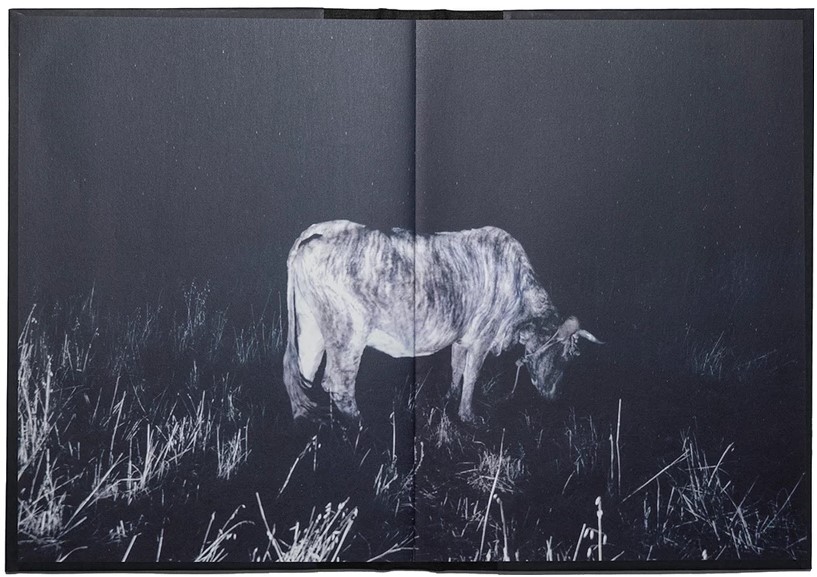
Yatromanolakis Yorgos, “The Splitting of the Chrysalis” pg 37

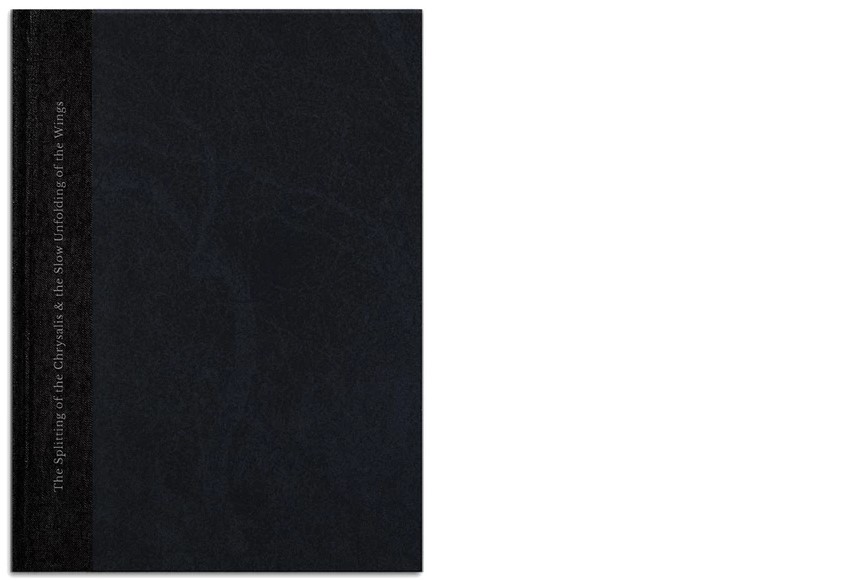
His project has been collected into a photo book that he has titled “The Splitting of the Chyrsalis & The Slow Unfolding of the Wings”. Below is the abstract excerpt which he has provided for the project.

Returning to the same place. I felt lost. Within a strange tranquility, something destructive arose inside me. I had sunk into a quiet desperation. I denied my past. I tried a hundred times to erase my memory. I was craving change. Flowing into the night, I became a wild animal. I confronted nature and death. I wanted to live. Feel every moment. Walk against the whistling wind. Breathe and dive into the cold sea. Harvest moon. Everything caught in fire. I walked with her in the blue dusk. Following my heartbeat. I lapsed into a transformation, an unexpected alignment with the stars.

Yatromanolakis Yorgos, Exerpt from project statement for “the splitting of the chrysalis & the slow unfolding of the wings” photo book.

I see in this work a stirring depiction of nature’s dual reality laid bare. A world in which opposite aspects exist simultaneously and the identifying inner qualities are able to take on a visible nature of their own.

The photographer’s words intrigue me as much as the images, pairing with them in a quiet harmony to crystalize the experience. I am left with many questions about the experience itself that all point to a strong connection of themes that I am already interested in. This includes the idea that being left to our own devices in nature, and therefore to our own inner nature, is a way to gain much needed insight.

There is also a wonderful description of the emergence from this trial, the destruction bringing growth all while the photographer was led by his own heartbeat, the inner pull of core values that pushes us forward towards what we are becoming. For all my interest in conscious introspection, I was taken aback by this reminder that the waves crash ever on, that we will follow our inner heartbeat wherever it takes us whether we know it or not.

Yatromanolakis Yorgos, “The Splitting of the Chrysalis” pg 45

Though unsettling to our preconceptions of a dictated and documented world, this project ultimately highlights the underlaying wellsprings of growth and fluidity of our existence with an emphasis on hope.

The book project can be viewed in full on the artists website here – Yatromanolakis Yorgos Books, The Splitting of the Chyrsalis – and can be viewed as an audio-visual experience as an online exhibition hosted by the Foam Museum in Amsterdam.

I encourage everyone to take a moment and flip through this project as a rare chance to tag along for an intensely personal journey of universal truth and growth.

Ferocious Harmony

As the wild winter winds blew snow sideways and shook the streetlights, I found myself travelling with incongruent balance those same chill streets.

On the intellectual level, it was a perfect example of core Taoist principles at work. Taoists understand that everything has its season and its nature. To work in accordance with the flow around you is to be successful with little effort. To work against the nature of the flow around you is to invite disaster and create difficult path for yourself.

I knew there would be rough weather and that I would be travelling by bike in the midst of it. I wore my layers and hood and extra hat, my heaviest coat and best gloves. I didn’t expect a quick or an easy ride, and brought my heavier slower cargo bike with the wider tires in case there was ice.

Instead of fighting the wind, which I had done on the way to work I found myself going in the same direction on my way home. In this situation, with the wind whipping around me and the glow of the streetlights dancing off of the freshly formed ice, I found myself warm and comfortable, barely feeling the wind as it gently helped me continue forward towards home.

Only in retrospect do I think back on it with an eye towards the lessons of harmony and going with the flow.

While I was in it, carried by the winds and surrounded by glittering trails of whipping ice crystals, I was allowed to be a center of awe and calm, an eye to this winter storm. This is the difference between knowledge and understanding, of dogma and experience. I will carry those images and feelings with me.